| |
| |

|
TRÁI TIM
MẸ: NƠI CON NƯƠNG NÁU - ĐƯỜNG ĐẾN VỚI CHÚA |
|
"Chúa Giêsu muốn dùng con để làm
cho Mẹ được nhận biết và yêu mến" |
|
November 14/2009 - Saturday of 32nd Week
of Ordinary Time
LITURGICAL/THEME MEDITATION:
"Always pray and do not lose heart"
UNIVERSAL CHURCH/WORLD EVENT(S):
Disciple of Secularism Turns
Catholic, Part 2
SAINT OF THE DAY
St. Gertrude
GENERAL
MARIOLOGY
The
birth of Mary the Holy Mother of God,
and very
glorious Mother of Jesus Christ
DIVINE MERCY
Divine Mercy in My Soul
NOTEBOOK VI
TEACHING/TESTIMONY/CONVICTION:
THE TRUTH ABOUT 'FAMILY
PLANNING'
|
|
DAILY LITURGICAL MEDITATION |
|
Saturday (11/14): "Always pray and do not
lose heart"
Scripture: Luke 18:1-8
1 And he told them a parable, to the effect that they ought always to
pray and not lose heart. 2 He said, "In a certain city there was a
judge who neither feared God nor regarded man; 3 and there was a widow
in that city who kept coming to him and saying, `Vindicate me against my
adversary.' 4 For a while he refused; but afterward he said to himself,
`Though I neither fear God nor regard man, 5 yet because this widow
bothers me, I will vindicate her, or she will wear me out by her
continual coming.'" 6 And the Lord said, "Hear what the unrighteous
judge says. 7 And will not God vindicate his elect, who cry to him day
and night? Will he delay long over them? 8 I tell you, he will vindicate
them speedily. Nevertheless, when the Son of man comes, will he find
faith on earth?"
Meditation: What can a shameless and unjust judge pitted
against a crusty and pestering woman teach us about justice and
vindication in the kingdom of God? Jesus tells a story that is all too
true – a defenseless widow is taken advantaged of and refused her
rights. Through sheer persistence she wears down an unscrupulous judge
until he gives her justice. Persistence pays off, and that's especially
true for those who trust in God. Jesus illustrates how God as our Judge
is much quicker to bring us his justice, blessing, and help when we need
it. But we can easily lose heart and forget to ask our heavenly Father
for his grace and help. Jesus told this parable to give fresh hope and
confidence to his disciples. In this present life we can expect trials
and adversity, but we are not without hope in God. The Last Judgment
will reveal that God's justice triumphs over all the injustices
perpetrated by his creatures and that God's love is stronger than death
(Song of Songs 8:6). The just who put their trust in God can look
forward with hope to that day when they will receive their reward.
Jesus ends his parable with a probing question for us. Will you and I
have faith – the faith that perseveres to the end – when Jesus returns
in glory to judge the living and the dead? Faith is an entirely free
gift that God makes to us. If we want to live, grow, and persevere in
faith until the end, then we must nourish our faith with the word of God
and ask the Lord to increase it (Luke 17:5). When trials and setbacks
disappoint you, where do you place your hope? Do you pray with expectant
faith and confidence in God's merciful care and providence for you?
"Lord Jesus, make my faith strong that I may never doubt your
promises. When I face trials and difficulties, help me to trust in your
unfailing love and to find joy and contentment in you alone."
Psalm 105:1-11
1 O give thanks to the LORD, call on his name, make known his deeds
among the peoples!
2 Sing to him, sing praises to him, tell of all his wonderful works!
3 Glory in his holy name; let the hearts of those who seek the LORD
rejoice!
4 Seek the LORD and his strength, seek his presence continually!
5 Remember the wonderful works that he has done, his miracles, and the
judgments he uttered,
6 O offspring of Abraham his servant, sons of Jacob, his chosen ones!
7 He is the LORD our God; his judgments are in all the earth.
8 He is mindful of his covenant for ever, of the word that he commanded,
for a thousand generations,
9 the covenant which he made with Abraham, his sworn promise to Isaac,
10 which he confirmed to Jacob as a statute, to Israel as an everlasting
covenant,
11 saying, "To you I will give the land of Canaan as your portion for an
inheritance."
www.dailyscripture.net
RETURN
TO TOP
|
|
UNIVERSAL CHURCH/WORLD EVENTS |
|
Disciple of Secularism Turns Catholic, Part 2
Vittorio Messori Speaks About His Own Conversion
By Nicolas de Cardenas
ROME, NOV. 13, 2009 ( Zenit.org).-
The journalist known for his interviews with Popes is
himself a convert from secularism. But his conversion
didn't mean giving up on reason, as he explains here.
In his latest book, Vittorio Messori has himself become
the subject of an interview, leading him to reveal his
story of conversion.
Messori, author of "The Jesus Hypothesis" (1976), is
the first journalist in history to publish a book-length
interview with a Pope, the best-selling "Crossing the
Threshold of Hope" (1994).
He also published "The Ratzinger Report" (1987),
based on an interview with then prefect of the
Congregation for the Doctrine of the Faith, Cardinal
Joseph Ratzinger.
In this interview with ZENIT, Messori talks about his
latest book, "Por qué creo" [Why I Believe] (published
by LibrosLibres in Spain), in which he is interviewed by
Vatican expert Andrea Tornielli.
Part
1 of this interview was published Thursday.
ZENIT: Let us now address a question of current
importance. How to you evaluate the fact that the
European Court of Human Rights has just decided that
Italian schools must remove crucifixes from the walls of
their classrooms because their presence might disturb
the children who are not Christians?
Messori: The concordat between the Italian state and
the Church states that the crucifix must be present in
schools and courts and this is perfectly in tune
with the Italian constitution.
I am saddened because these officials [the judges]
don't know anything, because for a long time the cross
has been more than a religious symbol; it is a human
symbol of justice, of suffering and of hope.
The position of laicism regarding the crucifix is
absurd, because the denial of the Christian roots of
Europe is not a sin against religion but against
history. Without St. Benedict or the Medieval Popes,
Europe wouldn't exist. It is a sin against history.
I am not scandalized because I believe that mass
Christianity is finished. Jesus says that his disciples
will always be a small group. I am not nostalgic for
mass Christianity, for the Spain at the [time of the]
Inquisition, for [a world in which] 90% of people go to
Mass on Sunday.
As Benedict XVI says, I believe that we Christians
must discover our own vocation.
ZENIT: Very many of your answers end by making a
defense of "et-et" (this and that), in contrast to "aut-aut"
(either this or that), as an essential characteristic of
Catholicism; it is the idea that "everything fits" in
the Church, an explanation of its unfathomable richness.
However, where is the limit between what fits within the
Church in some interpretation, and what doesn't fit
because it is contrary to it?
Messori: The fundamental principle of Catholicism, to
say it in Latin, is the "et-et," as opposed to the
principle of heresy "aut-aut."
Let us think of Protestantism, which is an "aut-aut":
Either the Bible or Tradition. Either Jesus Christ or
the Virgin and the saints. Either grace or free will.
Either Christ or the Pope. The heresy of Protestantism
chooses either this or that.
Whereas the motto of the Catholic is "I want all":
the Pope and the Bible, Jesus and his Mother, divine
grace and man's liberty, the Gospel and the Church.
Now, I believe that a Catholic must discover this
synthesis, of accepting everything that is good. This is
very important because today there is much Catholicism
subscribing to "aut-aut." The title of my next book will
be "We Want All."
ZENIT: You are a defender of the rationality of the
faith, of the existence of solid, almost scientific
reasons for credibility of the Church, and at the same
time a defender of miracles, a promoter of the Virgin's
apparitions. A Catholic understands this well, but how
do you explain it to an atheist?
Messori: There is no contradiction between faith and
reason. There isn't a battle.
Faith is the point of arrival of reason used to the
end. I am very grateful for what my university teachers
taught me, though they later denounced me. I have not
denounced them, because they taught me to use reason,
and to be a believer does not mean to give up reason but
to use it to the maximum.
I blame these teachers, [though] I esteem them, for
having converted reason to an ideology, rationalism,
which says there is nothing beyond reason. They must
understand that there are things beyond reason that
aren't against it, which encourages them to use it to
the end.
I have written much on the apparitions of Lourdes and
now I am finishing a volume on this subject. However, it
isn't a book of supernatural explanations, but research
on the historical plane of apparitions. In the end, I
must bow before the fact that history researched in
depth leads to mystery.
Half of my readers in Italy are believers, and the
other half are not. The majority of the latter are not
in agreement with my conclusions, but they are pleased
to follow my reasoning.
What I try to demonstrate is that the Christian is
not a cretin, he isn't someone who gives up the use of
reason.
The Christian is one who using reason, breaks the
walls of rationalism to come to a reality that is
greater than our own reason.
TURN TO TOP
|
|
DAILY LITURGICAL SAINT |
|
http://www.americancatholic.org/Features/SaintofDay
RETURN TO TOP
|
|
GENERAL
MARIOLOGY |
|
The
birth of Mary the Holy Mother of God,
and very
glorious Mother of Jesus Christ
The Protoevangelium of James
Apocrypha
| 22. And when Herod
knew that he had been mocked by the Magi, in a
rage he sent murderers, saying to them: Slay the
children (3) from two years old and under. And
Mary, having heard that the children were being
killed, was afraid, and took the infant and
swaddled Him, and put Him into an ox-stall.
And Elizabeth, having
heard that they were searching for John, took
him and went up into the hill-country, and kept
looking where to conceal him. And there was no
place of concealment. And Elizabeth, groaning
with a loud voice, says: O mountain of God,
receive mother and child. And immediately the
mountain was cleft, and received her. And a
light shone about them, for an angel of the Lord
was with them, watching over them.
23. And Herod
searched for John, and sent officers to
Zacharias, saying: Where hast thou hid thy son?
And he, answering, said to them: I am the
servant of God in holy things, and I sit
constantly in the temple of the Lord: I do not
know where my son is. And the officers went
away, and reported all these things to Herod.
And Herod was enraged, and said: His son is
destined to be king over Israel. And he sent to
him again, saying: Tell the truth; where is thy
son? for thou knowest that thy life is in my
hand. And Zacharias said: I am God's martyr, if
thou sheddest my blood; for the Lord will
receive my spirit, because thou sheddest
innocent blood at the vestibule of the temple of
the Lord. And Zacharias was murdered about
daybreak. And the sons of lsrael did not know
that he had been murdered.(4)
24. But at the hour
of the salutation the priests went away, and
Zacharias did not come forth to meet them with a
blessing, according to his custom. (5) And the
priests stood waiting for Zacharias to salute
him at the prayer, (6) and to glorify the Most
High. And he still delaying, they were all
afraid. But one of them ventured to go in, and
he saw clotted blood beside the altar; and he
heard a voice saying: Zacharias has been
murdered, and his blood shall not be wiped up
until his avenger come. And hearing this saying,
he was afraid, and went out and told it to the
priests. And they ventured in, and saw what had
happened; and the fretwork of the temple made a
wailing noise, and they rent their clothes (7)
from the top even to the bottom. And they found
not his body, but they found his blood turned
into stone. And they were afraid, and went out
and reported to the people that Zacharias had
been murdered. And all the tribes of the people
heard, and mourned, and lamented for him three
days and three nights. And after the three days,
the priests consulted as to whom they should put
in his place; and the lot fell upon Simeon. For
it was he who had been warned by the Holy Spirit
that he should not see death until he should see
the Christ in the flesh. (8)
And I James that
wrote this history in Jerusalem, a commotion
having arisen when Herod died, withdrew myself
to the wilderness until the commotion in
Jerusalem ceased, glorifying the Lord God, who
had given me the gift and the wisdom to write
this history. (1) And grace shall be with them
that fear our Lord Jesus Christ, to whom be
glory to ages of ages.
Amen. (2) |
|
RETURN TO TOP
|
|
DIVINE MERCY
|
Divine Mercy In my soul
The Mercy of the Lord I will sing Forever.
Divine Mercy in my soul.
Sr. Faustina, Diary
NOTEBOOK V I
J.M.J.
I felt that there is a
power which is defending me and protecting me from the blows of the enemy.
It guards and defends me. I feel it very distinctly; it is as if I am being
shielded by the shadow of His wings.
My Jesus, You alone are good. Even if my heart were to make every effort to
write of Your goodness, at least in part, I could not do so – this is beyond
all our comprehension.
One day during Holy Mass, the Lord give me a deeper knowledge of His
Holiness and His majesty and at the same time I saw my own misery. This
knowledge made me happy, and my soul drowned itself completely in His mercy.
I felt enormously happy.
On the following day, I had a clear awareness of the following words: “You
see, God is so Holy, and you are sinful. Do not approach Him, and go to
Confession every day.” And indeed, whatever I thought of seemed to me to be
a sin. But I did not omit going to Holy Communion, and I resolved to go to
Confession at the prescribed time, as I had no clear impediment. But when
the day for confession came, I prepared a whole mass of those sins of which
I was to accuse myself. However, in the confessional, God allowed me to
accuse myself of only two imperfections, despite my efforts to make a
confession according to what I had prepared. When I left the confessional,
the Lord said to me, My daughter, all those sins
you intended to confess are not sins in My eyes; that is why I took away
your ability to tell them. I understood that
satan, wanting to disturb my peace, has been giving me exaggerated thoughts.
O Savior, how great is Your goodness!
One day, when I was preparing for Holy Communion and noticed that I had
nothing to offer Him, I feel at His feet, calling down all His mercy upon my
poor soul: “My Your grace, which flows down upon me from Your compassionate
Heart, strengthen me for the struggle and sufferings, that I may remain
faithful to You. And, although I am such misery, I do not fear You, because
I know Your mercy well. Nothing will frighten me away from You, O God,
because everything is so much less than what I know Your mercy to be – I see
that clearly.

RETURN TO TOP
|
|
CATHOLIC TEACHING/CONVICTION/TESTIMONY |
|
THE TRUTH
ABOUT 'FAMILY PLANNING'
|
|
|
|
|
|
| by David Morrison
hen the U.S. Congress approved last month a measure
to disburse population control funds more speedily
around the world, Dr. Stephen Karanja, a Kenyan
obstetrician and gynecologist, was sorely disappointed.
Yet he understood why some lawmakers voted as they
did. "Many of those poor people in [Congress] do not
know what they are doing," he said. "They do not
understand what they are voting for."
Karanja is one of a small but growing number of
doctors, nurses and lay people in the Third World who
are willing to risk their careers and, in some cases,
fines and imprisonment to call attention to the havoc
U.S. population-control programs inflict on their lives
and countries.
Three days before the House of Representatives voted
on the measure Feb. 13, Karanja joined a fellow doctor
and two poor mothers from Mexico, as well as a nurse
from the Philippines, in an unprecedented press
conference in Washington.
Sponsored by the Population Research Institute, the
conference was intended to inform the American public --
particularly the 535 men and women in Congress -- that
U.S. taxpayer-supported programs in other countries
cannot be described as "family planning," but must be
seen as they really are: uninhibited population control.
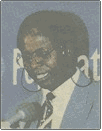
Dr. Karanja |
At the press conference, Karanja explained how the
health care system in Kenya has "collapsed" because so
much aid from the United States and other developed
nations has been diverted from basic health care into
"family planning."
"Thousands of Kenyan people will die of malaria --
when treatment costs but a few cents -- while health
facilities are stacked to the roof with millions of
dollars worth of pills, IUDs, Norplant and
Depo-Provera," he said. "And most of these are supplied
by American money."
Since Kenya lacks the medical infrastructure that
developed nations take for granted, many birth-control
devices made in the West are even more hazardous to
Kenyan women than they are to Westerners.
"Some of these contraceptives and abortifacients,
like Depo-Provera, cause terrible side effects to the
poor people in Kenya, who do not even have competent
medical check-ups before injection," Karanja explained.
"Many are maimed for life because the side effects of
these drugs -- blood clots, hypertension and menstrual
disorders, which can be dealt with effectively in the
West -- cannot be handled by our poorer health services.
Really, what is going on in Kenya is not 'family
planning' but a form of genocide."
While this may sound sensational, a close look at the
congressional report on Kenya of the U.S. Agency for
International Development (USAID) supports Karanja's
claims.
According to the agency, slightly more than $23
million of its budget will be spent in Kenya during
fiscal year 1997. Of that, the agency has slated nearly
$13.5 million for "fertility reduction" and "HIV/AIDS
prevention."
None of the documents relating to Kenya mention
much-needed drugs such as chloroquine (for malaria
treatment) or other basic medical supplies.
Nevertheless, the Agency for International Development
will consider its Kenyan program a success if
private-sector condom sales rise from this year's
500,000 per month to 1 million per month in the year
2000.
Kenyans are not alone in their plight brought on by
the United States' excessive emphasis on population
control, however. According to another physician at the
press conference, Mexican women are enduring a similar
fate.
Dr. Maria Garcia (not her real name) described the
"coercive practices" she has witnessed while working in
government hospitals in Mexico. The coercion begins when
a woman comes to the hospital to have a baby, Garcia
said.
Immediately, the woman is separated from her husband,
and she is not allowed to see him from the time of the
initial exam until she is discharged six hours after the
delivery. Then, during her initial exam, doctors ask how
she plans to avoid another pregnancy.
"If she answers, 'I plan to have more children,' or
'I plan to use the Billings Ovulation Method,' that is
not acceptable," Garcia said. "The doctors will continue
to harass her throughout her labor and delivery until
she says that she agrees to use contraception or have a
tubal ligation."
Many women submit to the pressure, which is
strategically applied at a time when they are very
vulnerable.
"I have seen women refuse to accept an IUD or
sterilization four or five times during the early stages
of labor, only to give in when the pain and pressure
became too intense" she said, adding that to coerce a
woman into making a contraceptive decision in such a way
is extremely bad medical practice.
"The patient is not asked her gynecological history.
A history of repeated vaginal infections, multiple
sexual partners, etc., are contra-indications to the use
of an IUD" Garcia said. "But since no history is taken,
these women are given an IUD nonetheless."
And even women who do manage to hold out against the
pressure still are given an IUD - over their objections.
At the press conference, two poor mothers from Mexico
told of how, against their wishes, IUDs were inserted
anyway, immediately after delivery.
This can be extremely hazardous to a woman's health,
Garcia explained. "Recently, a woman came to a clinic
where I was working to ask that her IUD be removed," she
said. "It had been inserted the previous month after the
birth of her baby.
"The doctor in charge told her that the pain and
abnormal bleeding that she was experiencing would
disappear within several months. He refused to remove
the IUD. She came back the following week, begging to
have it removed. I took it upon myself to remove it.
Infection was already apparent. This woman is now faced
with the possibility of further complications such as
adhesions, pelvic inflammatory disease or sterility--
serious side effects that may not be discovered until
later, if ever."
According to documents from the Agency for
International Development, the Mexican
population-control program is "succeeding," since
"contraceptive prevalence" has increased 8.3 percent
since 1995.
Also, more than $12 million of the $17 million the
agency will spend on aid Mexico will go toward
"fertility reduction."
At the press conference, the testimony of Bernadette
Ocampo, a nurse from the these Philippines, drew the
most attention. Ocampo's statement detailed what many on
Capitol Hill have long suspected: that U.S.
taxpayer-funded organizations are involved in promoting
and performing abortions overseas.

Bernadette
Ocampo |
"We are being subjected to propaganda paid for by
U.S.-funded population-control groups to change
attitudes to favor abortion," she said.
"There is an endless series of studies, surveys and
conferences being funded by these groups. Their aim is
to co-opt as many educational institutions and academic
leaders as possible to drum up media support and public
sympathy for the eventual legalization of abortion."
Ocampo pointed out that many high-level officials of
the Family Planning Organization of the Philippines, the
local affiliate of the International Planned Parenthood
Federation, have recently resigned under a cloud of
scandals over plans to perform abortions on Philippine
women.
She also noted that much of the Family Planning
Organization's funding comes, as in the cases of Kenya
and Mexico, from the U.S. Agency for International
Development.
"USAID had declared that one of its strategic
objectives in my country is a 'reduces fertility' rate
and improved 'maternal and child health,'" Ocampo said.
"But of the 25-plus million dollars it spends on
population and health, $22 million is for population
activities and less than $3 million is for health
services. Is USAID trying to help mothers in my country,
or just stop them from having children?"
(from Our Sunday Visitor)
|
|
RETURN TO TOP
|
|
Monthly Index
General Archive
2008
General Archive
2007
General Archive
2006
General Archive 2005
General Archive 2004 |
|
|
|

Hits since 3/16/2004
Màn điện
toán toàn cầu của Thiếu Nhi Fatima được bắt đầu với trang Main từ ngày
9/12/1999,
nhưng
mãi tới Mùa Hè 2001 mới tạm xong,
cuối
cùng đã được chỉnh trang về cả hình thức lẫn nội dung từ mùa hè năm
2002,
để rồi
chính thức tái ra mắt vào ngày 25/3/2003 cho đến nay.
TNFatima.org
do
Thiếu Nhi Fatima
chủ trương và thực hiện
Mọi ý kiến
đóng góp xin gửi về
Webmaster
|
|
|
|
|