| |
| |
|
TRÁI TIM
MẸ: NƠI CON NƯƠNG NÁU - ĐƯỜNG ĐẾN VỚI CHÚA |
|
"Chúa Giêsu muốn dùng con để làm
cho Mẹ được nhận biết và yêu mến" |
|
March 22, 2009 -
Sunday in 3rd Week of
Lent
LITURGICAL/THEME MEDITATION:
“God so loved the world that
he gave us his only Son”
UNIVERSAL CHURCH/WORLD EVENT(S):
Benedict XVI's Greetings at
Angolan Airport
SAINT OF THE DAY
St. Nicholas Owen
GENERAL
MARIOLOGY
Our Lady of Mount Carmel: History, the
Scapular, and Marian Mediation
Our Lady of Mount
Carmel and Fatima
DIVINE MERCY
On God's Will
In A
Mysterious Manner
TEACHING/TESTIMONY/CONVICTION:
Papal Address to Youth at
Dos Coqueiros Stadium
|
|
DAILY LITURGICAL MEDITATION |
|
“God so loved the world that he gave us his
only Son”
Gospel Reading: John 3:14-21
14 And as Moses lifted up the serpent in the wilderness, so must the
Son of man be lifted up, 15 that whoever believes in him may have
eternal life." 16 For God so loved the world that he gave his only Son,
that whoever believes in him should not perish but have eternal life. 17
For God sent the Son into the world, not to condemn the world, but that
the world might be saved through him. 18 He who believes in him is not
condemned; he who does not believe is condemned already, because he has
not believed in the name of the only Son of God. 19 And this is the
judgment, that the light has come into the world, and men loved darkness
rather than light, because their deeds were evil. 20 For every one who
does evil hates the light, and does not come to the light, lest his
deeds should be exposed. 21 But he who does what is true comes to the
light, that it may be clearly seen that his deeds have been wrought in
God.
Old Testament Reading: 2 Chronicles 36:14-16,19-23
14 All the leading priests and the people likewise were exceedingly
unfaithful, following all the abominations of the nations; and they
polluted the house of the LORD which he had hallowed in Jerusalem. 15
The LORD, the God of their fathers, sent persistently to them by his
messengers, because he had compassion on his people and on his dwelling
place; (2 Chronicles 36:14-15)
Meditation: Do you know the healing power of Christ's
redeeming love? The prophets never ceased to speak of God's faithfulness
and compassion towards those who would return to him with trust and
obedience (2 Chronicles 36:15). When Jesus spoke to Nicodemus he
prophesied that his death on the cross would bring healing and
forgiveness and a "new birth in the Spirit" (John 3:3) and eternal life
(John 3:15). Jesus explained the necessity of his crucifixion and
resurrection by analogy with Moses and the bronze serpent in the desert.
When the people of Israel journeyed in the wilderness, they complained
against the Lord and regretted ever leaving Egypt. God punished them for
their stubborn and rebellious hearts by sending a plague of deadly
serpents. When they repented and cried to the Lord for mercy, God
instructed Moses: "Make a fiery serpent, and set it on a pole; and every
one who is bitten, when he sees it, shall live" (Numbers 21:8).
The bronze serpent pointed to the cross of Christ which defeats sin
and death and obtains everlasting life for those who believe. The result
of Jesus "being lifted up on the cross" and his rising and exaltation to
the Father's right hand in heaven, is our "new birth in the Spirit" and
adoption as sons and daughters of God. God not only redeems us, but he
fills us with his own divine life and power that we might share in his
glory. Jesus gives us the Holy Spirit that we may have power to be his
witnesses and to spread and defend the gospel by word and action, and to
never be ashamed of the Cross of Christ. The Holy Spirit gives us his
seven-fold gifts of wisdom and understanding, right judgment and
courage, knowledge and reverence for God and his ways, and a holy fear
in God's presence (see Isaiah 11) that we may live for God and serve him
in the power of his strength. Do you thirst for new life in the Spirit?
How do we know, beyond a doubt, that God truly loves us and wants us
to be united with him forever? For God so loved the world that he
gave his only Son, that whoever believes in him should not perish but
have eternal life (John 3:16). God proved his love for us by giving
us the best he had to offer – his only begotten Son who freely gave
himself as an offering to God for our sake and as the atoning sacrifice
for our sin and the sin of the world. This passage tells us of the great
breadth and width of God's love. Not an exclusive love for just a few or
for a single nation, but an all-embracing redemptive love for the whole
world, and a personal love for each and every individual whom God has
created in his own image and likeness. God is a loving Father who cannot
rest until his wandering children have returned home to him. Saint
Augustine of Hippo says, "God loves each one of us as if there were only
one of us to love." God gives us the freedom to choose whom and what we
will love. Jesus shows us the paradox of love and judgment. We can love
the darkness of sin and unbelief or we can love the light of God’s
truth, beauty, and goodness. If our love is guided by what is true, and
good and beautiful then we will choose for God and love him above all
else. What we love shows what we prefer. Do you love God above all else?
Do you give him first place in your life, in your thoughts, decisions
and actions?
"Lord Jesus Christ, your death on the cross brought life, healing,
and pardon for us. May your love consume and transform my life that I
may desire you above all else. Help me to love what you love, to desire
what you desire, and to reject what you reject".
Psalm 137:1-6
1 By the waters of Babylon, there we sat down and wept, when we
remembered Zion.
2 On the willows there we hung up our lyres.
3 For there our captors required of us songs, and our tormentors, mirth,
saying, "Sing us one of the songs of Zion!"
4 How shall we sing the LORD's song in a foreign land?
5 If I forget you, O Jerusalem, let my right hand wither!
6 Let my tongue cleave to the roof of my mouth, if I do not remember
you, if I do not set Jerusalem above my highest joy!
www.dailyscripture.net
RETURN
TO TOP
|
|
UNIVERSAL CHURCH/WORLD EVENTS |
Benedict XVI's Greetings at Angolan Airport
"Your Land Is Abundant and Your Nation Is Mighty"
LUANDA, Angola, MARCH 20, 2009 ( Zenit.org).- Here is the address Benedict XVI gave today upon arriving at the Quatro de Fevereiro Airport in Luanda on the second phase of his international trip to Africa.
* * *
Mr President,
Distinguished Civil and Military Authorities,
Dear Brother Bishops,
Dear Angolan Friends,
With sincere sentiments of respect and friendship, I set foot on the soil of this noble and young nation in the course of a pastoral visit in which I intend to reach out to the entire African continent, even if it has been necessary to restrict the itinerary to Yaoundé and to Luanda. I would like everyone to know, however, that I keep very much in my heart and in my prayers Africa in general and the people of Angola in particular, whom I warmly encourage to continue along the path of peace-building and reconstruction of the country and its institutions.
Mr President, I begin by thanking you for your kind invitation to visit Angola and for the warm words of welcome that you have just addressed to me. Please accept my respectful greetings and my very best wishes, which I also extend to the other Authorities who have kindly come here to receive me. I greet the whole of the Catholic Church in Angola in the persons of the Bishops here present, and I thank all my Angolan friends for the affectionate welcome they have given me. To those who are listening on radio and television, I offer a further cordial greeting, certain of Heaven’s blessing on the common mission that has been entrusted to us: that of building together a freer and more peaceful society, marked by greater solidarity.
How can I fail to recall the famous visitor who blessed Angola in June 1992: my beloved Predecessor John Paul II? A tireless missionary of Jesus Christ to the furthest ends of the earth, he pointed out the way towards God, inviting all people of good will to listen to their own rightly formed consciences and to build a society of justice, of peace and of solidarity, in mutual charity and forgiveness. For my part, I remind you that I come from a country where peace and fraternity are dear to the hearts of all its people, in particular those, like myself, who have known war and division between family members from the same nation as a result of inhuman and destructive ideologies, which, under the false appearance of dreams and illusions, caused the yoke of oppression to weigh down upon the people. You can therefore understand how keenly aware I am of dialogue as a way of overcoming every form of conflict and tension and making every nation -- including your own -- into a house of peace and fraternity. With this in view, you must take from your spiritual and cultural heritage the best values that Angola possesses, and go out to meet one another fearlessly, agreeing to share personal resources, both spiritual and material, for the good of all.
How can our thoughts not turn also to the people from the province of Kunene, who have been afflicted by torrential rains and floods, causing numerous deaths and leaving many families without shelter through the destruction of their homes? At this time I would like to offer those people the assurance of my solidarity, together with a particular encouragement to have the confidence to start again with the help of all.
Dear Angolans, your land is abundant and your nation is mighty. Make use of these advantages to build peace and understanding between peoples, based upon loyalty and equality that can promote for Africa the peaceful future in solidarity that everyone longs for and to which everyone is entitled. To this end, I ask you: do not yield to the law of the strongest! God has enabled human beings to fly, over and above their natural tendencies, on the wings of reason and faith. If you let these wings bear you aloft, you will easily recognize your neighbour as a brother or sister, born with the same fundamental human rights. Unfortunately, within the borders of Angola, there are still many poor people demanding that their rights be respected. The multitude of Angolans who live below the threshold of absolute poverty must not be forgotten. Do not disappoint their expectations!
This is a huge task, requiring greater civic participation on everyone’s part. It is necessary to involve the whole of Angolan civil society in this effort; but society needs to grow stronger and more articulated, both among its constitutive elements and in its dialogue with the Government, before it can take up the challenge. Before there can be a society that is truly solicitous for the common good, there have to be common values, shared by all. I am convinced that modern Angola will be able to find such values in the Gospel of Jesus Christ, as happened long ago, at the time of your illustrious forebear, Dom Alphonsus I Mbemba-a-Nzinga. Through his efforts, five hundred years ago, a Christian kingdom emerged in Mbanza Congo which survived until the eighteenth century. From its ashes, at the turn of the nineteenth and twentieth centuries, a renewed Church could arise which has continued to grow right up to our own days; may God be thanked for it! This is the immediate occasion for my visit to Angola: to be together with one of the oldest Catholic communities in sub-equatorial Africa, to strengthen it in its faith in the risen Jesus and to join its sons and daughters in praying that this time of peace in Angola, in justice and fraternity, may prove lasting, allowing the community to carry out the mission that God has entrusted to it for the good of its people within the family of Nations. May God bless Angola!
© Copyright 2009 -- Libreria Editrice Vaticana
RETURN
TO TOP
|
|
DAILY LITURGICAL SAINT |
|

March 22, 2009
St. Nicholas Owen
(d. 1606)
Nicholas, familiarly known as "Little John," was small in stature but
big in the esteem of his fellow Jesuits.
Born at Oxford, this humble artisan saved the lives of many priests and
laypersons in England during the penal times (1559-1829), when a series
of statutes punished Catholics for the practice of their faith. Over a
period of about 20 years he used his skills to build secret hiding
places for priests throughout the country. His work, which he did
completely by himself as both architect and builder, was so good that
time and time again priests in hiding were undetected by raiding
parties. He was a genius at finding, and creating, places of safety:
subterranean passages, small spaces between walls, impenetrable
recesses. At one point he was even able to mastermind the escape of two
Jesuits from the Tower of London. Whenever Nicholas set out to design
such hiding places, he began by receiving the Holy Eucharist, and he
would turn to God in prayer throughout the long, dangerous construction
process.
After many years at his unusual task, he entered the Society of Jesus
and served as a lay brother, although—for very good reasons—his
connection with the Jesuits was kept secret.
After a number of narrow escapes, he himself was finally caught in 1594.
Despite protracted torture, he refused to disclose the names of other
Catholics. After being released following the payment of a ransom,
"Little John" went back to his work. He was arrested again in 1606. This
time he was subjected to horrible tortures, suffering an agonizing
death. The jailers tried suggesting that he had confessed and committed
suicide, but his heroism and sufferings soon were widely known.
He was canonized in 1970 as one of the 40 Martyrs of England and Wales.
Comment:
Nicholas was a clever builder and architect who used his skills to
protect endangered priests. Without his help, hundreds of English
Catholics would have been deprived of the sacraments. His gift for
spotting unlikely places to hide priests was impressive, but more
impressive was his habit of seeking support for his work in prayer and
the Eucharist. If we follow his example, we may also discover surprising
ways to put our skills to God’s service.
http://www.americancatholic.org/Features/SaintofDay
RETURN TO TOP
|
|
GENERAL
MARIOLOGY |
Our Lady of Mount Carmel: History, the
Scapular, and Marian Mediation
By Amy Farrell
Our
Lady of Mount Carmel and Fatima
In
the sixth apparition of Fatima on October 13, 1917, the Blessed Virgin
Mary first appeared as Our Lady of the Rosary (58). After Our Lady of
the Rosary spoke with the children, she disappeared into the distance.
Then followed a series of three visions: St. Joseph with the child
Jesus, followed by Our Lady of Sorrows and then Our Lady of Mount
Carmel. After this series of visions, approximately 70,000 onlookers
witnessed the solar miracle in which the sun "danced in the sky" and
appeared to plummet toward the earth (59). Many have speculated that
these three visions represent the mysteries of the Rosary, in which the
vision of Our Lady of Mount Carmel with the Scapular, corresponds to the
Glorious Mysteries, pointing to the significance of Our Lady and the
Scapular in obtaining Eternal Life (60).
The
importance of the Scapular promise is conveyed based on Our Lady’s
message to the world, "You have seen hell where the souls of poor
sinners go. To save them, God wishes to establish in the world devotion
to my Immaculate Heart" (61). In the fourth apparition, Our Lady tells
the children again to pray the Rosary daily, for world peace and the end
of the First World War, and that "only she can help you" (62). She
teaches the children the prayer attached to the Rosary, "O my Jesus,
forgive us, save us from the fires of hell. Lead all souls to heaven,
especially those who are most in need" (63). In these words, she reveals
the parallel importance of the Scapular and consecration to her
Immaculate Heart. In the seventh apparition to Sr. Lucia on December 10,
1925, Our Lady appeared with the Child Jesus who said, "Have compassion
on the Heart of your most Holy Mother, covered with thorns, with which
ungrateful men pierce it at every moment, and there is no one to make an
act of reparation to remove them" (64). In this seventh apparition, Our
Lady promises Sr. Lucia to "assist at the hour of death, with the graces
necessary for salvation" those who on five consecutive first Saturdays
fulfill the following conditions: 1) receive sacramental confession; 2)
receive Holy Communion; 3) pray five decades of the Rosary; and 4) "keep
me company" while meditating for fifteen minutes on any number of the
Rosary mysteries, with the intention of making reparation to her
Immaculate Heart (65). This promise is in accordance with the Scapular
promise, both which emphasize Our Lady’s role, determined by Our Lord,
to assist her children in achieving eternal salvation.
Our
Lady of Mount Carmel and the Life of the Christian
It is
evident in the messages of Fatima, that Our Lady is teaching the world
about establishing devotion to her Immaculate Heart. Let us consider, in
summary, how consecration to the Immaculate Heart of Mary is related to
Our Lady of Mount Carmel. In order to consider this relationship, it is
necessary to turn the attention again to the meaning of "Mount Carmel."
In a
conference on Our Lady of Mount Carmel, Fr. John Corapi, S.O.L.T.,
speaks of the mystical yet real relation between Carmel and the
Immaculate Heart of Mary. Carmel or "Garden of God," is a place where
fruit is brought forth. Thus, Carmel prefigures the perfect Garden of
God, Mary’s Immaculate Heart. The Immaculate Heart of Mary is where
Jesus, "the Life" (Jn 14:6) is found. Many saints, including St. Leo and
St. Augustine, explain that Mary conceived Jesus in her heart before He
was conceived in her womb. God dwells in the Immaculate Heart of Mary,
the Garden of God, where He calls us also to dwell and to be nourished
with the life of Grace. Mary said "yes" to God and conceived Jesus, "the
Life" Himself. Her Immaculate Heart is the perfect environment for
supernatural life to flourish, as in her Immaculate Heart the Garden of
God is found. Every garden requires a principle of life; in the
Immaculate Heart of Mary, the Garden of God, this is God the Father. A
garden likewise requires another principle of life: the sun. Jesus the
Son of God and Son of Mary gives the Garden warmth, love and sheds the
light of truth. Likewise, every garden needs water. The living water of
Eternal life, the Holy Spirit, nourishes and gives life to the Garden
(and all that is planted in the garden). The Father, Son, and Holy
Spirit dwell in Mary’s Immaculate Heart, so we take refuge in this
"Garden of God," Mary’s Immaculate Heart, where God dwells. Thus Carmel
shows us the way to the preeminent Garden of God, the Immaculate Heart
of Mary. It is here that her children are to take refuge and to live in
God’s Grace (66).
In
returning to the reflection on the meaning of "Carmel" in light of Our
Lady of Mount Carmel, and the significance for our world today, consider
the three Scriptural citations mentioned in the Introduction. These
characteristics by no means exhaust the symbolic significance of Mount
Carmel, yet they provide the means for a deepened understanding.
Mount
Carmel is a place of gathering of God’s children where He conquers evil
and idolatry:
"Now
therefore send and gather all Israel to me at Mount Carmel, and the four
hundred and fifty prophets of Ba'al and the four hundred prophets of
Ashe'rah, who eat at Jez'ebel's table." So Ahab sent to all the people
of Israel, and gathered the prophets together at Mount Carmel (1 Kings
18:19, 20).
The
Lord told Elijah to gather His people on Mount Carmel, where a great
spiritual battle would take place. Here, Elijah restored the Israelites
to the covenant with God, as the false god, Ba’al is defeated and the
Lord is again worshiped as the true God. Our Lady of Mount Carmel wishes
to gather her children together, in the Spirit of Carmel, assisting her
children in offering our lives in the service of Our Lord, through
prayer and sacrifice, willing to engage in a spiritual battle which will
bring about the ultimate victory of good over evil. The gathering on
Mount Carmel in the Old Testament, points to the reality that today we
must be united in this battle, under the mantle of Our Lady, the woman
who crushes the head of the serpent (Gen 3:15). The Scapular speaks of
the Blessed Mother’s victory over evil, as she promises that those who
die wearing the Scapular will not suffer eternal fire. In other words,
through the protection of Our Lady of Mount Carmel, the soul will not be
lost to Satan. Our Lord was revealed as the true God on Mount Carmel,
conquering the pagan god, Ba’al. As Mount Carmel symbolizes Our Lord’s
triumph over evil, this will happen through the maternal intercession of
Our Lady of Mount Carmel who promises salvation to her children who
strive to remain united to her.
http://www.motherofallpeoples.com/index.php?option=com_content&task=view&id=1617&Itemid=40
RETURN TO TOP
|
|
DIVINE MERCY
|

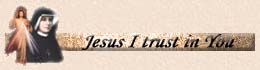
Divine Mercy In my soul
Preface
The diary of Sister Maria Faustina H. Kowalska is the record
of her life experience – the journey of her soul. She was
graces by a special communion with God, and the diary
expresses her conviction that this communion ought to be the
center of our lives. Since the 1940’s the Marians of the
Immaculate Conception, St. Stanislaus Kostka Province, have
shared this conviction and have undertaken the promulgation
of God’s mercy throughout the world, particularly as it has
been proclaimed by Sister Faustina.
In 1979, convinced of the importance of the diary, the
Marians were instrumental in bringing it – in its rough
typewritten form – out of Poland. We made the necessary
corrections to the manuscript and published a critical
Polish edition that has been promulgated throughout the
world to Polish speaking people.
At the same time, we commissioned a couple in Poland, Adam
and Danuta Pasicki, to translate the diary into English.
Once they had completed this first, literal translation, we
asked Archbishop George Pearce, S.M., to re-translate
portions of it in accordance with proper English terminology
for the various theological concepts and spiritual
experiences referred to throughout the diary. Archbishop
Pearce was supported in this second translation by Fahters
George Kosicki, C.S.B., Gerald Farrel, M.M., Leo McCauley,
S.J, and an Oblate, Francis Baga, O.M.I.
When this text was completed, it was given to Father
Seraphim Michalenko, M.I.C, who was Director of the Divine
Mercy Department from 1979-1986. Together with Sister Sophia
Michalenko, C.M.G.T., he carefully reviewed the translation,
often referring back to the original Polish to ensure
exactness of expression. Father Joseph Sielski, M.I.C and
Father Kazimierz, M.I.C., were then asked to review the
text, re-reading it for authentic agreement with the Polish.
Finally, in the first part of 1987, the text was returned to
the Divine Mercy Department, now headed by Father George
Kosicki, C.S.B. through his efforts, the tireless work of
Sister Sophia Michalenko, C.M.G.T, and the assistance of
Vincent Flynn, the diary was subjected to a complete
editing, re-typing, and proofing process for clarity of
expression and readability according to current English
grammar and usage. The index, listing the main themes of the
diary, was compiled by Father Eugene Ozimek and developed by
Fr. George Kosicki and Sister Sophia. The design,
composition, and mechanicals were then completed by Charles
Parise and Pat Menatti, and the diary was printed by the
Marian Press at the Marian helpers center. To all involved
with this work, we wish to express our deepest gratitude and
the assurance of our prayers.
Since the Polish diary is the official text, we have made
every effort to be truly faithful to it, and to retain the
various shades of meaning implied in the theological and
spiritual terms used by Sister Faustina – a definite
challenge, indeed! In translating the diary, we dealt with
the same kind of challenge that faces the translators of
Sacred Scripture. Some terms allow for a variety of
expressions even though the meanings are the same, and the
final translation thus becomes a personal choice of style
and expression on the part of the translator.
For the most part, the texts that have already been
published in the popular devotional booklets are the same as
those used in the diary, though in some instances, there
again may be slight differences of style and expression.
Special Features of this New English Edition
In the final editing process, inconsistencies of verb tense,
capitalization, and punctuation were standardized as much as
possible without losing Sister Faustina’s unique style and
powerful simplicity of expression. Our Lord’s words to
Sister Faustina were set in Bold Type (We, Sue and Marianne,
Put Our Lord’s words in Red,
Our Lady’s in Blue, and
Angels in Purple) for
emphasis, while Our Lady’s words were set in Italics. The
page numbers of Sister Faustina’s original notebooks were
also set in bold type, and paragraphs thought to be overly
long or diversified in content were split into shorter
paragraph units for readability.
The footnotes too, have been reexamined, and additional
clarifying notes have been added where necessary. Notes that
were no longer pertinent, in light of changes incorporated
into the English translation, were deleted; and, wherever
possible, explanatory notes were placed in [square brackets]
in the text itself to avoid unnecessary breaks in the
reading.
Our deepest hope is that this diary may truly be a vehicle
of grace for all who read it, for in reading it we can see
that the mercy of God lives forever.
Above all, we hope that all people will be struck by the
truth that mankind will not have
peace until it turns with trust to God’s mercy.
May each one of you experience the power of the Blood
and Water that poured out from the Heart of Jesus as a fount
of mercy, and may each of you find confidence and trust in
this ever present mercy of God!
Gratefully in the Lord,
Very Rev. Richard J. Drabik, M.I.C.
Provincial Superior
Eden Hill, Stockbridge, Massachusetts
March 19, 1987.
ORIGINAL PREFACE TO THE POLISH EDITION, 1981
In presenting this edition of the Diary of Sister Faustina
Kowalska I am fully aware that I am introducing a document
of Catholic mysticism of exceptional worth, not only for the
Church in Poland, but also for the Universal Church. This
publication is the critical edition, and thus reliable. It
is the work of the Postulator of Sister Faustina, under the
direction of the authority of the Archdiocese of Cracow.
The Diary, whose object is devotion to the Divine Mercy, has
acquired tremendous interest lately for two reasons:
Firstly: the Sacred Congregation for the Doctrine of the
Faith, in its revision more then two years ago [1978],
withdrew the consures and reservations advanced earlier by
the Holy See in relation to the writings of Sister Faustina.
The withdrawal of the “Notification” caused the devotion to
the Divine Mercy, as presented in the Diary, to grow in
renewed vitality on all continents, as is evidenced by the
numerous testimonies received by the Postulator and the
Congregation of which Sister Faustina was a member.
Secondly: The recent encyclical of Pope John Paul II,
Dives in Misericordia,
happily fixed the attention of the Church, and even of the
secular world, on this most wonderful attribute of God and
extraordinary aspect of the economy of salvation, which is
the Divine Mercy.
A comprehensive study in order to indicate the affinity of
ideas found in the Diary of Sister Faustina and this
encyclical (not to mention their probable interdependence)
would be most welcome. These salient points certainly are
numerous, for they draw their inspiration from the same
source; namely, from the revelation of God and the teaching
of Christ.
Furthermore, they come from the same spiritual environment,
from Cracow, the city which, as far as I know, possesses the
oldest Church dedicated to the honor of the Divine Mercy. It
is likewise necessary to stress that it was Karol Cardinal
Wojtyla, the Archbishop of Cracow at that time, who made
efforts to begin the Process of Beatification of Sister
Faustina Kowalska and did inaugurate that process.
In this light, the Diary of Sister Faustina took on
exceptional meaning for the Catholic spirituality; and that
is why it was fitting to prepare a credible edition, in
order to prevent distortion of the text by persons who
perhaps are acting in good faith, but who are not adequately
prepared for such work. Thus, publications containing
differences and even contradictions, such as took place with
the spiritual diary of St. Therese of the Child Jesus,
The Story of a Soul, can be
avoided.
The reader, after just a superficial skimming of the Diary,
may be struck by the simplicity of the language and even by
the spelling and stylistic errors, but he should not forget
that the author of the Diary had but a limited elementary
education. The theology alone which is found in the Dairy
awakens in the reader a conviction of its uniqueness; and if
one considers the contrast between Sister Faustina’s
education and the loftiness of her theology, the contrast
alone indicates the special influence of Divine Grace.
I would like to mention here my meeting with a well known
contemporary mystic, Sister Speranza, who in Collevalenza,
not far from Todi [Italy], founded the sanctuary of “The
Most Merciful Love,” the site of numerous pilgrimages.
I asked Sister Speranza whether she had heard of the
writings of Sister Faustina and what she thought of them.
She answered me with simplicity: “The writings contain a
wonderful teaching. But reading them one must remember that
God speaks to philosophers in the language of philosophers
and to simple souls in the language of the simple ones, and
only to these last does He reveal truths hidden from the
wise and prudent of this world.”
To conclude this preface, permit me to mention yet one more
personal recollection from the year 1952, when for the first
time I took part in a solemn beatification ceremony in St.
Peter’s Basilica. After the festivity I was asked by some
persons who also participated, “Who exactly was this blessed
one?”
The question embarrassed me very much, because at the moment
I could not recall who those blessed were, although I knew
full well that the real purpose of a beatification is to
present to the People of God a model to consider and imitate
in their lives.
Among the candidates for beatification and canonization,
Poland has presently two persons familiar to the whole
world, which knows who they are, what they accomplished in
their lifetime and what sort of message their lives
proclaim. They are Blessed [now Saint] Maximilian Kolbe, the
martyr of love, and Sister Faustina Kowalska, [now Saint]
the Apostle of the Divine Mercy.
Rome, December 20, 1980
Andrew M. Deskur
Titular Archbishop of Tene.
This I confess with utmost humility.
http://our.homewithgod.com/divinemercy/book5/
RETURN TO TOP |
|
CATHOLIC TEACHING/CONVICTION/TESTIMONY |
Papal Address to Youth at Dos Coqueiros Stadium
"The Power to Shape the Future Is Within You"
LUANDA, Angola, MARCH 21, 2009 ( Zenit.org).- Here is the address Benedict XVI gave today at a meeting with youth at Dos Coqueiros Stadium in Luanda.
* * *
Dear Friends,
You have come here in great numbers to be with the Successor of Peter, and you represent so many other young people who are one with us in spirit. You have come to join me in proclaiming openly the joy of our faith in Jesus Christ, and in renewing your commitment to be his faithful disciples in our time. A meeting much like this took place here in Luanda on June 7, 1992 with our beloved Pope John Paul II. Today another Pope stands before you: with a different appearance, but with the same love in his heart, and he embraces all of you in Jesus Christ, who is "the same yesterday, today and forever" (Heb 13:8).
First of all I want to thank you for this celebration which you have planned for me, for the festive atmosphere which you yourselves generate, for your presence and for your joy. I cordially greet my brother Bishops and priests and all those who are engaged in youth ministry. I likewise greet with gratitude all who have prepared this event, especially the Bishops' Commission for Young People and Vocations, and its President, Bishop Kanda Almeida, whom I thank for his warm words of welcome. I greet all the young people present, Catholics and others, who are looking for an answer to their questions and difficulties. Some of these have been expressed by your representatives, and I have listened to them with gratitude and appreciation. The embrace I exchanged with them is, naturally, an embrace which I offer to all of you.
Meeting young people is good for everyone! You may have your share of difficulties, but you are filled with great hope, great enthusiasm and a great desire to make a new beginning. My young friends, you hold within yourselves the power to shape the future. I encourage you to look to that future through the eyes of the Apostle John. Saint John tells us: "I saw a new Heaven and a new earth ... and I saw the holy city, the new Jerusalem, coming down out of Heaven, from God, prepared as a bride adorned for her husband; and I heard a loud voice from the throne saying, 'Behold the dwelling of God is with men'" (Rev 21:1-3). Dear young people, God makes all the difference. His special presence among us begins with his easy intimacy with the first couple in the garden of Eden; it continues with the divine glory which shone forth from the Tent of Meeting in the midst of the People of Israel during their journey through the desert, and it culminates in the incarnation of the Son of God who became inseparably one with humanity in Jesus Christ. Jesus himself traversed the desert of our humanity and, passing beyond death, he rose from the dead and now draws all humanity with himself towards God. Jesus is no longer confined to a particular place and time. His Spirit, the Holy Spirit, flows forth from him, enters our hearts and thus joins us to him, and with him to the Father -- to the God who is one and three.
Yes, my friends! God makes all the difference ... and more! God changes us; he makes us new! This is what he has promised: "Behold, I make all things new" (Rev 21:5). It is true! The Apostle Paul tells us: "If anyone is in Christ, he is a new creation; the old has passed away, behold the new has come. All this is from God, who through Christ reconciled himself to us" (2 Cor 5:17-18). In ascending to Heaven and entering eternity, Jesus Christ has become the Lord of all ages. So he can walk with us as a friend in the present, carrying in his hand the book of our days. In his hand he also holds the past, the foundation and source of our life. He also carefully holds the future, allowing us to catch a glimpse of the most beautiful dawn we will ever see: the dawn that radiates from him, the dawn of the Resurrection. God is the future of a new humanity, which is anticipated in his Church. When you have a chance, take time to read the Church's history. You will find that the Church does not grow old with the passing of the years. Rather, she grows younger, for she is journeying towards her Lord, day by day drawing nearer to the one true fountain overflowing with youthfulness, rebirth, the power of life.
Dear young people, the future is God. As we have just heard, "he will wipe away every tear from their eyes, and death shall be no more; neither shall there be mourning, nor crying nor pain any more, for the former things have passed away" (Rev 21:4). At present though, and even in our midst, I see some of the many thousands of young Angolans who have been maimed or disabled as a result of the war and the landmines. I think of the countless tears that have been shed for the loss of your relatives and friends. It is not hard to imagine the dark clouds that still veil the horizon of your fondest hopes and dreams. In your hearts I see doubt, a doubt which you have expressed to me today. You are saying: "Here is what we have. There is no visible sign of the things you are talking about! The promise is backed by God's word -- and we believe it -- but when will God arise and renew all things?" Jesus' answer is the one he gave to his disciples: "Let not your hearts be troubled. Believe in God. Believe also in me. In my Father's house there are many rooms; if it were not so, would I have told you that I go to prepare a place for you?" (Jn 14:1-2). But you persist, dear young people: "Yes! But when will this happen?" The Apostles asked Jesus a similar question, and his answer was: "It is not for you to know times or seasons which the Father has fixed by his own authority. But you shall receive power when the Holy Spirit has come upon you; and you shall be my witnesses ... to the ends of the earth" (Acts 1:7-8). See how Jesus does not leave us without an answer; he tells us one thing very clearly: renewal starts from within; you will receive a power from on high. The power to shape the future is within you.
It is within you, but how? Just as life exists within a seed. That is how Jesus explained it at a critical juncture in his ministry. The beginning of his ministry was accompanied by great enthusiasm. People saw the sick healed, demons cast out, the Gospel proclaimed, but otherwise the world had not changed: the Romans remained in power and everyday life continued to be hard, despite those miracles and those beautiful words. People's enthusiasm was waning so much that even some of his disciples had left the Master (cf. Jn 6:66) who preached but did not change the world. Everyone was asking: deep down, what value does this message have? What has this prophet of God brought us? It was then that Jesus spoke about the sower who sows in the field of the world, and he explained that the seed is his word (Mk 4:3-20) and his miracles of healing. These are so few in comparison to the immense needs and demands of everyday life. And yet, deep within the seed, the future is already present, since the seed contains tomorrow's bread, tomorrow's life. The seed seems almost nothing. But it is the presence of the future, the promise already present. When it falls on good soil, it produces fruit, thirty, sixty and even a hundredfold.
My dear friends, you are a seed which God has sown in the world, a seed that contains power from on high, the power of the Holy Spirit. And yet, the only way to pass from the promise of life to actually bearing fruit is to give your lives in love, to die for love. Jesus himself said: "Unless a grain of wheat falls to the earth and dies, it remains alone; but if it dies, it bears much fruit. He who loves his life loses it, and he who hates his life in this world will keep it for eternal life" (Jn 12:24-25). This is what Jesus said, and this is how he acted. His crucifixion seems like complete failure, but it is not! Jesus, in the power of "the eternal Spirit, offered himself without blemish to God" (Heb 9:14). Thus, once he fell to the earth, he could bear fruit in every time and place. In your midst you have the new Bread, the Bread of future life, the Most Holy Eucharist, which nourishes us and pours out the life of the Trinity into the hearts of all people.
Dear young people, as seeds filled with the power of the same eternal Spirit, sprout up before the warmth of the Eucharist, in which the Lord's testament is fulfilled: he gives himself to us and we respond by giving ourselves to others, for love of him. This is the way that leads to life; it can be followed only by maintaining a constant dialogue with the Lord and among yourselves. The dominant societal culture is not helping you to live by Jesus' word or to practise the self-giving to which he calls you in accordance with the Father's plan. Yet, dear friends, you have the power within you, just as it was in Jesus when he said: "the Father who dwells in me does his works... he who believes in me, will also do the works that I do; and he will do greater works than these, because I go to the Father" (Jn 14:10,12). So do not be afraid to make definitive decisions. You do not lack generosity -- that I know! But the idea of risking a lifelong commitment, whether in marriage or in a life of special consecration, can be daunting. You might think: "The world is in constant flux and life is full of possibilities. Can I make a life-long commitment now, without knowing what unforeseen events lie in store for me? By making a definitive decision, would I not be risking my freedom and tying my own hands?" These are the doubts you feel, and today's individualistic and hedonist culture aggravates them. Yet when young people avoid decisions, there is a risk of never attaining to full maturity!
I say to you: Take courage! Dare to make definitive decisions, because in reality these are the only decisions which do not destroy your freedom, but guide it in the right direction, enabling you to move forward and attain something worthwhile in life. There is no doubt about it: life is worthwhile only if you take courage and are ready for adventure, if you trust in the Lord who will never abandon you. Young people of Angola, unleash the power of the Holy Spirit within you, the power from on high! Trusting in this power, like Jesus, risk taking a leap and making a definitive decision. Give life a chance! In this way islands, oases and great stretches of Christian culture will spring up in your midst, and bring to light that "holy city coming down out of Heaven, from God, prepared as a bride adorned for her husband". This is the life worthy of being lived, and I commend it to you from my heart. May God bless the young people of Angola!
© Copyright 2009 -- Libreria Editrice Vaticana
RETURN TO TOP
|
|
Monthly Index
General Archive
2008
General Archive
2007
General Archive
2006
General Archive 2005
General Archive 2004 |
|
|
|

Hits since 3/16/2004
Màn điện
toán toàn cầu của Thiếu Nhi Fatima được bắt đầu với trang Main từ ngày
9/12/1999,
nhưng
mãi tới Mùa Hè 2001 mới tạm xong,
cuối
cùng đã được chỉnh trang về cả hình thức lẫn nội dung từ mùa hè năm
2002,
để rồi
chính thức tái ra mắt vào ngày 25/3/2003 cho đến nay.
TNFatima.org
do
Thiếu Nhi Fatima
chủ trương và thực hiện
Mọi ý kiến
đóng góp xin gửi về
Webmaster
|
|
|
|
|