| |
| |
|
TRÁI TIM
MẸ: NƠI CON NƯƠNG NÁU - ĐƯỜNG ĐẾN VỚI CHÚA |
|
"Chúa Giêsu muốn dùng con để làm
cho Mẹ được nhận biết và yêu mến" |
|
January 29, 2009 - Thursday in 3rd
Week of Ordinary Time
LITURGICAL/THEME MEDITATION:
"The measure you give will be the measure you
get"
UNIVERSAL CHURCH/WORLD EVENT(S):
Benedict XVI Expresses
Solidarity With Jews
SAINT OF THE DAY
Servant of God
Brother Juniper
GENERAL
MARIOLOGY
THE
MESSAGE OF FATIMA
FIRST AND SECOND PART OF THE “SECRET”
DIVINE MERCY
On Mercy
I Offer Everything
for Sinners
TEACHING/TESTIMONY/CONVICTION:
Pope On Paul's Letters to
Early Bishops

|
|
DAILY LITURGICAL MEDITATION |
|
"The measure you give will be the measure you
get"
Scripture: Mark 4:21-25
21 And he said to them, "Is a lamp brought in to be put under a
bushel, or under a bed, and not on a stand? 22 For there is nothing hid,
except to be made manifest; nor is anything secret, except to come to
light. 23 If any man has ears to hear, let him hear." 24 And he said to
them, "Take heed what you hear; the measure you give will be the measure
you get, and still more will be given you. 25 For to him who has will
more be given; and from him who has not, even what he has will be taken
away."
Meditation: What does the image of light and a lamp tell us
about God's kingdom? Lamps in the ancient world served a vital function,
much like they do today. They enable people to see and work in the dark
and to avoid stumbling. The Jews also understood "light" as an
expression of the inner beauty, truth, and goodness of God. In his
light we see light ( Psalm 36:9). His word is a lamp that guides
our steps (Psalm 119:105). God's grace not only illumines the
darkness in our lives, but it also fills us with spiritual light, joy,
and peace. Jesus used the image of a lamp to describe how his disciples
are to live in the light of his truth and love. Just as natural light
illumines the darkness and enables one to see visually, so the light
of Christ shines in the hearts of believers and enables us to see
the heavenly reality of God's kingdom. In fact, our mission is to be
light-bearers of Christ so that others may see the truth of the
gospel and be freed from the blindness of sin and deception.
Jesus remarks that nothing can remain hidden or secret. We can try to
hide things from others, from ourselves, and from God. How tempting to
shut our eyes from the consequences of our sinful ways and bad habits,
even when we know what those consequences are. And how tempting to hide
them from others and even from God. But, nonetheless, everything is
known to God who sees all. There is great freedom and joy for those who
live in God's light and who seek this truth. Those who listen to God and
heed his voice will receive more from him. Do you know the joy and
freedom of living in God's light?
"Lord Jesus, you guide me by the light of your saving truth. Fill my
heart and mind with your light and truth and free me from the blindness
of sin and deception that I may see your ways clearly and understand
your will for my life. May I radiate your light and truth to others in
word and deed."
Psalm 132:1-5, 11-14
1 Remember, O LORD, in David's favor, all the hardships he endured;
2 how he swore to the LORD and vowed to the Mighty One of Jacob,
3 "I will not enter my house or get into my bed;
4 I will not give sleep to my eyes or slumber to my eyelids,
5 until I find a place for the LORD, a dwelling place for the Mighty One
of Jacob."
11 The LORD swore to David a sure oath from which he will not turn
back: "One of the sons of your body I will set on your throne.
12 If your sons keep my covenant and my testimonies which I shall teach
them, their sons also for ever shall sit upon your throne."
13 For the LORD has chosen Zion; he has desired it for his habitation:
14 "This is my resting place for ever; here I will dwell, for I have
desired it.
www.dailyscripture.net
RETURN
TO TOP
|
|
UNIVERSAL CHURCH/WORLD EVENTS |
Benedict XVI Expresses Solidarity With Jews
Vatican Spokesman Hopes Statement Clarifies Church
Position
By Mirko Testa
VATICAN CITY, JAN. 28, 2009 ( Zenit.org).-
Benedict XVI expressed solidarity with Jews and strongly
condemned the use of concentration camps during World War II
in his response to the uproar caused by lifting the
excommunication of a holocaust-denying bishop.
Speaking today after delivering his weekly general audience
address, the Pope addressed for the first time a rift that
began Saturday when the Vatican lifted the excommunication
of Lefebvrite Bishop Richard Williamson.
The bishop had appeared days earlier on Swedish television
claiming that historical evidence denies the gassing of Jews
in Nazi concentration camps. He also alleged that no more
than 300,000 Jews were killed during World War II.
Bishop Williamson was one of four prelates of the Society of
St. Pius X who were illicitly ordained to the episcopate by
Archbishop Marcel Lefebvre in 1988. The excommunication was
also lifted for the other three bishops, and was meant to be
a step toward healing the division caused by the ordinations
some 20 years ago.
Today the Pontiff acknowledged the horror of the Holocaust,
and especially the death camps such as Auschwitz, which he
said "carried out the brutal massacre of millions of Jews,
innocent victims of a blind racial and religious hate."
The Pope expressed his "hope that the memory of the Shoah
moves humanity to reflect on the unpredictable power of evil
when it conquers the human heart," and that the Holocaust
"be for everyone a warning against forgetting, against
negating or reductionism, because violence committed against
even one human being is violence against all."
"No man is an island," Benedict XVI continued, referring to
the English Poet John Donne (1571-1631).
"May the Shoah teach especially, as much the old generations
as the new ones, that only the tiring path of listening and
dialogue, of love and pardon, leads peoples, cultures and
religions of the world to the desired encounter of
fraternity and peace in the world," he said. "May violence
never again humiliate the dignity of man!"
Sufficient
Jesuit Father Federico Lombardi, director of the Vatican
press office, said immediately following the audience that
the Pope's statements on the Holocaust "should be more than
sufficient to respond to the questions of those who doubt
the position of the Pope and the Catholic Church."
Since the weekend, reports had been circulating that the
Rabbinate of Israel would indefinitely sever ties with the
Vatican, which were established in 2000 when Pope John Paul
II visited Israel, and cancel a meeting of the Commission
for Religious Relations of the Holy See set for March.
The Vatican and the state of Israel have had their own,
separate relationship since establishing diplomatic ties in
1993, and the current situation does not affect state
relations.
Father Lombardi said today he hoped that "the difficulties
presented by the Rabbinate of Israel can be the object of a
subsequent and more profound reflection," and that
Vatican-Jewish relations "can go forward fruitfully and
serenely."
In an interview that aired today on Italian television, Oded
Wiener, the director-general of the Rabbinate of Israel,
affirmed the importance of relations with the Vatican: "I
think that it is fundamental as much for us as for the
Vatican itself."
Regarding Benedict XVI's comments after the general
audience, Wiener underlined: "In the first place I believe
that the declaration of the Pope this morning have been
extremely important, for us and for the entire world. There
is no place for people such as Williamson that deny the
existence of the Holocaust."
"I think it has been a big step forward," he added.
The Israeli ambassador to the Holy See, Mordechay Lewy, said
he was "very happy for a declaration from such a high level
by the Holy See that clarifies and helps to overcome these
misunderstanding."
"I think that it is erroneous, now, to personalize the
question concentrating on a single bishop," he added.
With regard to the intention of Benedict XVI to travel to
the Holy Land in May, the Israeli ambassador said "the Pope
is welcome in Israel today, as he was welcomed yesterday and
the day before."
[Adapted by Karna Swanson]
RETURN
TO TOP
|
|
DAILY LITURGICAL SAINT |
|

January 29, 2009
Servant of God Brother Juniper
(d. 1258)
"Would to God, my brothers, I had a whole forest of such Junipers," said
Francis of this holy friar.
We don’t know much about Juniper before he joined the friars in 1210.
Francis sent him to establish "places" for the friars in Gualdo Tadino
and Viterbo. When St. Clare was dying, Juniper consoled her. He was
devoted to the passion of Jesus and was known for his simplicity.
Several stories about Juniper in the Little Flowers of St. Francis
illustrate his exasperating generosity. Once Juniper was taking care of
a sick man who had a craving to eat pig’s feet. This helpful friar went
to a nearby field, captured a pig and cut off one foot, and then served
this meal to the sick man. The owner of the pig was furious and
immediately went to Juniper’s superior. When Juniper saw his mistake, he
apologized profusely. He also ended up talking this angry man into
donating the rest of the pig to the friars!
Another time Juniper had been commanded to quit giving part of his
clothing to the half-naked people he met on the road. Desiring to obey
his superior, Juniper once told a man in need that he couldn’t give the
man his tunic, but he wouldn’t prevent the man from taking it either. In
time, the friars learned not to leave anything lying around, for Juniper
would probably give it away.
He died in 1258 and is buried at Ara Coeli Church in Rome.
Comment:
What can we make of Juniper? He certainly seems to be the first of many
Franciscan "characters." No doubt some of the stories about him have
improved considerably in the retelling. Although the stories about
Juniper may seem a little quaint, his virtues were not. He was humble
because he knew the truth about God, himself and others. He was patient
because he was willing to suffer ("patience" comes from patior
meaning "to suffer") in his following of Jesus.
Quote:
It
is said that St. Francis once described the perfect friar by citing "the
patience of Brother Juniper, who attained the state of perfect patience
because he kept the truth of his low estate constantly in mind, whose
supreme desire was to follow Christ on the way of the cross" (Mirror
of Perfection, #85).http://www.americancatholic.org/Features/SaintofDay
RETURN TO TOP
|
|
GENERAL
MARIOLOGY |
CONGREGATION
FOR THE DOCTRINE OF THE FAITH
THE
MESSAGE OF FATIMA
THE
“SECRET” OF FATIMA
FIRST
AND SECOND PART OF THE “SECRET”
ACCORDING TO THE VERSION PRESENTED BY SISTER LUCIA
IN THE “THIRD MEMOIR” OF 31 AUGUST 1941 FOR THE BISHOP OF LEIRIA-FATIMA
(original text)

(translation) (6)
...
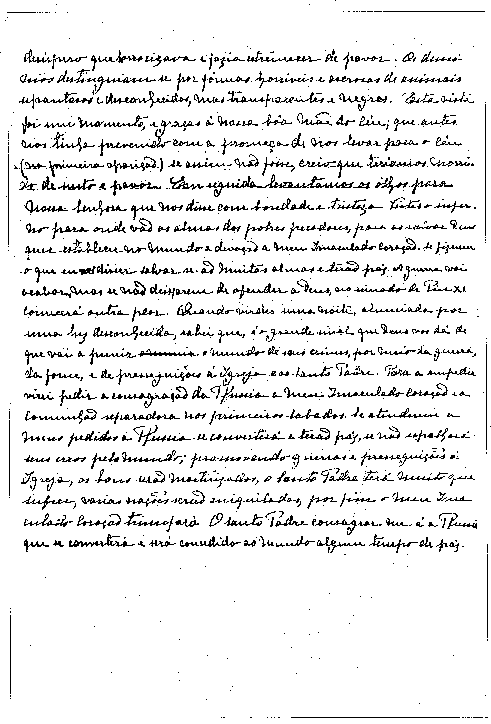
This will entail my speaking about the secret, and thus answering the
first question.
What
is the secret? It seems to me that I can reveal it, since I already have
permission from Heaven to do so. God's representatives on earth have
authorized me to do this several times and in various letters, one of
which, I believe, is in your keeping. This letter is from Father José
Bernardo Gonçalves, and in it he advises me to write to the Holy Father,
suggesting, among other things, that I should reveal the secret. I did
say something about it. But in order not to make my letter too long,
since I was told to keep it short, I confined myself to the essentials,
leaving it to God to provide another more favourable opportunity.
In my
second account I have already described in detail the doubt which
tormented me from 13 June until 13 July, and how it disappeared
completely during the Apparition on that day.
Well,
the secret is made up of three distinct parts, two of which I am now
going to reveal.
The
first part is the vision of hell.
Our
Lady showed us a great sea of fire which seemed to be under the earth.
Plunged in this fire were demons and souls in human form, like
transparent burning embers, all blackened or burnished bronze, floating
about in the conflagration, now raised into the air by the flames that
issued from within themselves together with great clouds of smoke, now
falling back on every side like sparks in a huge fire, without weight or
equilibrium, and amid shrieks and groans of pain and despair, which
horrified us and made us tremble with fear. The demons could be
distinguished by their terrifying and repulsive likeness to frightful
and unknown animals, all black and transparent. This vision lasted but
an instant. How can we ever be grateful enough to our kind heavenly
Mother, who had already prepared us by promising, in the first
Apparition, to take us to heaven. Otherwise, I think we would have died
of fear and terror.
We
then looked up at Our Lady, who said to us so kindly and so sadly:
“You
have seen hell where the souls of poor sinners go. To save them, God
wishes to establish in the world devotion to my Immaculate Heart. If
what I say to you is done, many souls will be saved and there will be
peace. The war is going to end: but if people do not cease offending
God, a worse one will break out during the Pontificate of Pius XI. When
you see a night illumined by an unknown light, know that this is the
great sign given you by God that he is about to punish the world for its
crimes, by means of war, famine, and persecutions of the Church and of
the Holy Father. To prevent this, I shall come to ask for the
consecration of Russia to my Immaculate Heart, and the Communion of
reparation on the First Saturdays. If my requests are heeded, Russia
will be converted, and there will be peace; if not, she will spread her
errors throughout the world, causing wars and persecutions of the
Church. The good will be martyred; the Holy Father will have much to
suffer; various nations will be annihilated. In the end, my Immaculate
Heart will triumph. The Holy Father will consecrate Russia to me, and
she shall be converted, and a period of peace will be granted to the
world”.(7)
RETURN TO TOP
|
|
DIVINE MERCY
|
On Mercy
I Offer Everything for
Sinners
Jesus, give me the souls
of sinners; let Your mercy rest upon them. Take everything
away from me, but give me souls. I want to become a
sacrificial host for sinners (Diary, 908).
† "Jesus, I offer everything today for sinners. Let the
blows of Your justice fall on me, and the sea of Your mercy
engulf the poor sinners" (Diary, 927).
The soul gives the greatest glory to its Creator when it
turns with trust to The Divine Mercy (Diary, 930).
RETURN TO TOP |
|
CATHOLIC TEACHING/CONVICTION/TESTIMONY |
Pope On
Paul's
Letters to
Early
Bishops
"Scripture
Is Read
Correctly by
Putting
Oneself in
Dialogue"
VATICAN
CITY,
JAN. 28,
2009 ( Zenit.org).-
Here is
a
translation
of the
address
Benedict
XVI gave
today in
Paul VI
Hall at
the
general
audience.
* * *
Dear
brothers
and
sisters:
The
final
letters
of the
Pauline
collection,
about
which I
would
like to
speak
today,
are
called
the
pastoral
letters,
because
they
were
sent to
unique
figures
among
the
pastors
of the
Church:
two to
Timothy
and one
to
Titus,
close
collaborators
with St.
Paul.
In
Timothy,
the
Apostle
saw
almost
an alter
ego; in
fact he
entrusted
him with
important
missions
(in
Macedonia:
cf. Acts
19:22;
in
Thessalonica:
cf. 1
Timothy
3:6-7;
in
Corinth:
cf. 1
Corinthians
4:17;
16:10-11)
and
afterward
he wrote
flattering
praise
of him:
"For I
have no
one
comparable
to him
for
genuine
interest
in
whatever
concerns
you"
(Philippians
2:20).
According
to the
4th-century
Church
History
of
Eusebius
of
Caesarea,
Timothy
was
later
the
first
bishop
of
Ephesus
(cf.
3,4).
Regarding
Titus,
he must
have
also
been
very
beloved
by the
Apostle,
who
defined
him
explicitly
as "full
of zeal
… my
companion
and
collaborator"
(2
Corinthians
8:17,23),
and even
more "my
true son
in the
common
faith"
(Titus
1:4). He
had been
entrusted
with a
couple
very
delicate
missions
in the
Church
of
Corinth,
the
results
of which
comforted
Paul
(cf. 2
Corinthians
7:6-7,13;
8:6).
Straight
away,
from
what we
know,
Titus
caught
up to
Paul in
Nicopolis
of
Epirus,
in
Greece
(cf.
Titus
3:12)
and was
later
sent by
him to
Dalmatia
(cf. 2
Timothy
4:10).
According
to the
letter
directed
to him,
he ended
up being
the
bishop
of Crete
(cf.
Titus
1:5).
The
letters
directed
to these
two
pastors
occupy
an
entirely
unique
spot in
the New
Testament.
It seems
to the
majority
of
exegetes
today
that
these
letters
wouldn't
have
been
written
by Paul
himself,
and that
their
origin
would be
in the
"Pauline
school"
and
reflected
his
inheritance
to a new
generation,
perhaps
integrating
some
brief
writing
or word
from the
Apostle
himself.
For
example,
some
words
from the
Second
Letter
to
Timothy
seem so
authentic
that
they
could
only
have
come
from the
heart
and lips
of the
Apostle.
Undoubtedly
the
ecclesial
situation
that
emerges
in these
letters
is
distinct
from
that of
the
central
years of
Paul's
life. He
now,
retrospectively,
defines
himself
as
"herald,
apostle
and
teacher"
of the
pagans
in the
faith
and in
the
truth
(cf. 1
Timothy
2:7; 2
Timothy
1:11);
he
presents
himself
as one
who has
obtained
mercy
because
Jesus
Christ
-- he
writes
thus --
"might
display
all his
patience
as an
example
for
those
who
would
come to
believe
in him
for
everlasting
life" (1
Timothy
1:16).
Therefore
the
essence
is that
truly in
Paul,
persecutor
converted
by the
presence
of the
Risen
One,
appears
the
magnanimity
of the
Lord for
our
encouragement,
to
motivate
us to
hope and
have
trust in
the
mercy of
the Lord
who,
despite
our
littleness,
can do
great
things.
Besides
the
central
years of
Paul's
life,
the
[letters]
imply as
well new
cultural
contexts.
In fact,
there is
allusion
to the
appearance
of
teachings
considered
totally
erroneous
or false
(cf. 1
Timothy
4:1-2; 2
Timothy
3:1-5),
such as
those
who
professed
that
matrimony
was not
good
(cf. 1
Timothy
4:3a).
We see
how
modern
this
concern
is,
because
today as
well
Scripture
is
sometimes
read as
an
object
of
historical
curiosity
and not
as the
Word of
the Holy
Spirit,
in which
we can
hear the
very
voice of
the Lord
and
recognize
his
presence
in
history.
We could
say
that,
with
this
brief
list of
errors
in the
Letters,
an
outline
is
appearing
from
beforehand
of that
successive
erroneous
orientation
we know
by the
name of
Gnosticism
(cf. 1
Timothy
2:5-6; 2
Timothy
3:6-8).
The
author
confronts
these
doctrines
with two
underlying
calls.
One
consists
in a
return
to a
spiritual
reading
of
sacred
Scripture
(cf. 2
Timothy
3:14-17),
that is,
a
reading
that
considers
it truly
as
"inspired"
and
coming
from the
Holy
Spirit,
such
that
with it
one can
be
"instructed
for
salvation."
Scripture
is read
correctly
by
putting
oneself
in
dialogue
with the
Holy
Spirit,
to take
from it
light
"for
teaching,
for
refutation,
for
correction,
and for
training
in
righteousness"
(2
Timothy
3:16).
In this
sense,
the
letter
adds:
"so that
one who
belongs
to God
may be
competent,
equipped
for
every
good
work" (2
Timothy
3:17).
The
other
call
consists
in the
reference
to the
good
"deposit"
(parathéke):
It is a
special
word
from the
pastoral
letters
with
which is
indicated
the
tradition
of the
apostolic
faith
that
must be
protected
with the
help of
the Holy
Spirit
who
dwells
in us.
This
so-called
deposit
should
be
considered
as the
sum of
apostolic
Tradition
and as
the
standard
for
fidelity
to the
proclamation
of the
Gospel.
And here
we
should
keep in
mind
that in
the
pastoral
letters,
as in
all of
the New
Testament,
the term
"Scriptures"
explicitly
means
the Old
Testament,
because
the
writings
of the
New
Testament
either
didn't
exist
yet or
still
did not
form
part of
a canon
of
Scriptures.
Therefore
the
Tradition
of the
apostolic
proclamation,
this
"deposit,"
is the
reading
key to
understand
Scripture,
the New
Testament.
In this
sense,
Scripture
and
Tradition,
Scripture
and the
apostolic
proclamation
as key
for
reading,
approach
and
almost
merge to
form
together
"God's
solid
foundation"
(2
Timothy
2:19).
The
apostolic
proclamation,
that is,
Tradition,
is
necessary
to
introduce
oneself
in the
understanding
of
Scripture
and
capture
in it
the
voice of
Christ.
It is
necessary
in fact
to be
"holding
fast to
the true
message
as
taught"
(Titus
1:9). At
the base
of
everything
is
precisely
faith in
the
historical
revelation
of the
goodness
of God,
who in
Jesus
Christ
has
concretely
manifested
his
"love
for
man," a
love
that in
the
original
Greek
text is
meaningfully
designated
as
filanthropía
(cf.
Titus
3:4; 2
Timothy
1:9-10);
God
loves
humanity.
Taken
together,
it is
clearly
seen
that the
Christian
community
goes
configuring
itself
in very
clear
terms,
according
to an
identity
that not
only
stays
distant
from
incongruent
interpretations,
but
above
all
affirms
its own
anchor
in the
essential
points
of the
faith,
that
here is
synonymous
with
"truth"
(1
Timothy
2:4,7;
4:3;
6:5; 2
Timothy
2:15,18,25;
3:7,8;
4:4;
Titus
1:1,14).
In the
faith,
the
essential
truth of
who we
are
appears,
of who
is God,
and how
we
should
live.
And from
this
truth
(the
truth of
the
faith)
the
Church
is
defined
as
"pillar
and
foundation"
(1
Timothy
3:15).
In any
case, it
remains
as an
open
community,
of
universal
reach,
that
prays
for all
men of
every
class
and
condition
so they
come to
know the
truth.
"God
wants
everyone
to be
saved
and to
come to
knowledge
of the
truth"
because
"Jesus
has
given
himself
as
ransom
for all"
(1
Timothy
2:4-5).
Thus the
sense of
universality,
though
the
communities
are
still
small,
is
strong
and
determinant
for
these
letters.
Moreover
this
Christian
community
"slanders
no one"
and
"exercises
all
graciousness
toward
everyone"
(Titus
3:2).
This is
a first
important
component
of these
letters:
the
universality
of the
faith as
truth,
as the
reading
key to
sacred
Scripture,
to the
Old
Testament,
and thus
it
delineates
a unity
in the
proclamation
of
Scripture
and a
living
faith
open to
all and
witness
of the
love of
God for
all.
Another
typical
component
of these
letters
is a
reflection
on the
ministerial
structure
of the
Church.
It is
these
[letters]
that
present
for the
first
time the
triple
subdivision
of
bishops,
presbyters
and
deacons
(cf. 1
Timothy
3:1-13;
4:13; 2
Timothy
1:6;
Titus
1:5-9).
We can
observe
in the
pastoral
letters
the
joining
of two
distinct
ministerial
structures
and thus
the
make-up
of the
definitive
form of
ministry
in the
Church.
In the
Pauline
letters
of the
central
years of
his
life,
Paul
speaks
of "episcopi"
(Philippians
1:1) and
of "diaconi":
This is
the
typical
structure
of the
Church
that
formed
in the
epoch of
the
pagan
world.
The
figure
of the
apostle
himself
remains,
therefore,
dominant,
and
because
of this
only
little
by
little
are the
rest of
the
ministries
developed.
If, as I
have
said, in
the
Churches
formed
in the
pagan
world we
have
bishops
and
deacons,
and not
presbyters,
in the
Churches
formed
in the
Judeo-Christian
world,
the
presbyters
are the
dominant
structure.
At the
end in
the
pastoral
letters,
the two
structures
unite:
Now
appears
the "episcopo"
(the
bishop)
(cf. 1
Timothy
3:2;
Titus
1:7),
always
in
singular,
accompanied
by the
determinant
article
"the."
And
together
with the
"episcopo"
we find
the
presbyters
and
deacons.
Still
now the
figure
of the
apostle
is
determinant,
but the
three
letters,
as I
have
said,
are
directed
not now
to
communities,
but to
people:
Timothy
and
Titus,
who on
one hand
appear
as
bishops,
and on
the
other,
begin to
be in
the
place of
the
Apostle.
Thus is
noted
initially
the
reality
that
will
later be
called
"apostolic
succession."
Paul
says
with a
tone of
great
solemnity
to
Timothy:
"Do not
neglect
the gift
you
have,
which
was
conferred
on you
through
the
prophetic
word
with the
imposition
of hands
of the
presbyterate"
(1
Timothy
4:14).
We can
say that
in these
words
appears
initially
also the
sacramental
character
of the
ministry.
And thus
we have
the
essential
of the
catholic
structure:
Scripture
and
Tradition,
Scripture
and
proclamation,
forming
a whole;
but to
this
structure
that we
could
call
doctrinal,
should
be added
the
personal
structure,
the
successors
of the
apostles,
as
witnesses
of the
apostolic
proclamation.
It is
important
finally
to
indicate
that in
these
letters
the
Church
understands
herself
in very
human
terms,
in
analogies
with the
house
and the
family.
Particularly
in 1
Timothy
3:2-7,
very
detailed
instructions
for the
episcopo
are
given,
such as:
"Therefore,
a bishop
must be
irreproachable,
married
only
once,
temperate,
self-controlled,
decent,
hospitable,
able to
teach,
not a
drunkard,
not
aggressive,
but
gentle,
not
contentious,
not a
lover of
money.
He must
manage
his own
household
well,
keeping
his
children
under
control
with
perfect
dignity;
for if a
man does
not know
how to
manage
his own
household,
how can
he take
care of
the
church
of God?
… He
must
also
have a
good
reputation
among
outsiders."
One
should
note
here
above
all the
important
aptitude
for
teaching
(also
cf. 1
Timothy
5:17),
of which
we find
echoes
as well
in other
passages
(cf. 1
Timothy
6:2c; 2
Timothy
3:10;
Titus
2:1) and
then a
special
personal
characteristic,
that of
"paternity."
The
episcopo
in fact
is
considered
as
father
of the
Christian
community
(cf.
also 1
Timothy
3:15).
Futhermore
the idea
of the
Church
as
"house
of God"
sinks
its
roots in
the Old
Testament
(cf.
Numbers
12:7)
and is
found
reformulated
in
Hebrews
3:2,6,
meanwhile
in
another
place it
is read
that all
Christians
are no
longer
foreigners
nor
guests,
but
fellow
citizens
of the
saints
and
family
members
in the
house of
God (cf.
Ephesians
2:19).
Let us
pray to
the Lord
and to
St. Paul
so that
also
today,
as
Christians,
we can
be ever
more
characterized,
in
relation
with the
society
in which
we live,
as
members
of the
"family
of God."
And let
us pray
also
that the
pastors
of the
Church
have
more and
more
paternal
sentiments,
simultaneously
gentle
and
strong,
in the
formation
of the
house of
God, of
the
community,
of the
Church.
RETURN TO TOP
|
|
Monthly Index
General Archive
2008
General Archive
2007
General Archive
2006
General Archive 2005
General Archive 2004 |
|
|
|

Hits since 3/16/2004
Màn điện
toán toàn cầu của Thiếu Nhi Fatima được bắt đầu với trang Main từ ngày
9/12/1999,
nhưng
mãi tới Mùa Hè 2001 mới tạm xong,
cuối
cùng đã được chỉnh trang về cả hình thức lẫn nội dung từ mùa hè năm
2002,
để rồi
chính thức tái ra mắt vào ngày 25/3/2003 cho đến nay.
TNFatima.org
do
Thiếu Nhi Fatima
chủ trương và thực hiện
Mọi ý kiến
đóng góp xin gửi về
Webmaster
|
|
|
|
|