| |
| |
|
TRÁI TIM
MẸ: NƠI CON NƯƠNG NÁU - ĐƯỜNG ĐẾN VỚI CHÚA |
|
"Chúa Giêsu muốn dùng con để làm
cho Mẹ được nhận biết và yêu mến" |
|
April 2, 2009 - Thursday
in Fifth Week of Lent
LITURGICAL/THEME MEDITATION:
"Before Abraham was, I am"
UNIVERSAL CHURCH/WORLD EVENT(S):
Notre Dame Students Organize
Prayer Rally Protest
SAINT OF THE DAY
St.
Francis of Paola

GENERAL
MARIOLOGY
THE DIVINE
HISTORY AND LIFE
OF THE
VIRGIN MOTHER OF GOD
THE IMMACULATE
CONCEPTION
DIVINE MERCY
Divine Mercy in My Soul
Notebook I
TEACHING/TESTIMONY/CONVICTION:
On Benedict XVI's Africa
Trip
|
|
DAILY LITURGICAL MEDITATION |
|
"Before Abraham was, I am"
Gospel Reading: John 8:51-59
51 Truly, truly, I say to you, if any one keeps my word, he will
never see death." 52 The Jews said to him, "Now we know that you have a
demon. Abraham died, as did the prophets; and you say, `If any one keeps
my word, he will never taste death.' 53 Are you greater than our father
Abraham, who died? And the prophets died! Who do you claim to be?" 54
Jesus answered, "If I glorify myself, my glory is nothing; it is my
Father who glorifies me, of whom you say that he is your God. 55 But you
have not known him; I know him. If I said, I do not know him, I should
be a liar like you; but I do know him and I keep his word. 56 Your
father Abraham rejoiced that he was to see my day; he saw it and was
glad." 57 The Jews then said to him, "You are not yet fifty years old,
and have you seen Abraham?" 58 Jesus said to them, "Truly, truly, I say
to you, before Abraham was, I am." 59 So they took up stones to throw at
him; but Jesus hid himself, and went out of the temple.
Old Testament Reading: Genesis 17:3-9
3 Then Abram fell on his face; and God said to him, 4 "Behold, my
covenant is with you, and you shall be the father of a multitude of
nations. 5 No longer shall your name be Abram, but your name shall be
Abraham; for I have made you the father of a multitude of nations. 6 I
will make you exceedingly fruitful; and I will make nations of you, and
kings shall come forth from you. 7 And I will establish my covenant
between me and you and your descendants after you throughout their
generations for an everlasting covenant, to be God to you and to your
descendants after you.
Meditation: Do you submit to Jesus' words as if your life
depended on it? Jesus made a claim which only God can make – "if any one
keeps my word, he will never see death." St. Augustine of Hippo, in his
commentary on John's Gospel, explains this verse: "It means nothing less
than he saw another death from which he came to free us – the second
death, eternal death, the death of hell, the death of the damned, which
is shared with the devil and his angels! This is the real death;
the other kind of death is only a passage." [Tractates
on the Gospel of John 43.10-11]
When God established a relationship with Abraham, he offered him an
unbreakable "everlasting covenant" (Genesis 17:7). Jesus came to fulfill
that covenant so that we could know the living God and be united with
him both now and for all eternity. God made us to know him and to be
united with him and he gives us the gift of faith and understanding so
that we may grow in the knowledge of what he has accomplished for us
through his Son, Jesus Christ. Jesus challenged the people of Israel to
accept his word as the very revelation of God himself. His claim
challenged the very foundation of their belief and understanding of God.
Jesus made a series of claims which are the very foundation of his life
and mission. What are these claims? First, Jesus claims unique knowledge
of God as the only begotten Son of the Father in heaven. Since he claims
to be in direct personal communion with his Father in heaven, he knows
everything about the Father. Jesus claims that the only way to full
knowledge of the mind and heart of God is through himself. Jesus also
claims unique obedience to God the Father. He thinks, lives and acts
in the knowledge of his Father's word. To look at his life is to
"see how God wishes me to live." In Jesus alone we see what God wants us
to know and what he wants us to be.
When the Jewish authorities asked Jesus who do you claim to be?
he answered, "before Abraham was, I am." Jesus claims to be timeless
and there is only one in the universe who is timeless, namely God.
Scripture tells us that "Jesus Christ is the same yesterday and today
and forever" (Hebrews 13:8). Jesus was not just a man who came, lived,
died, and then rose again. He is the immortal timeless One, who always
was and always will be. In Jesus we see the eternal God in visible
flesh. He is God who became a man for our sake and for our salvation.
His death and resurrection make it possible for us to share in his
immortality. Do you believe the words of Jesus and obey them with all
your heart, mind, and strength?
"Lord Jesus, let your word be on my lips and in my heart that I may
walk in the freedom of your everlasting love, truth and goodness."
Psalm 105:4-9
4 Seek the LORD and his strength, seek his presence continually!
5 Remember the wonderful works that he has done, his miracles, and the
judgments he uttered,
6 O offspring of Abraham his servant, sons of Jacob, his chosen ones!
7 He is the LORD our God; his judgments are in all the earth.
8 He is mindful of his covenant for ever, of the word that he commanded,
for a thousand generations,
9 the covenant which he made with Abraham, his sworn promise to Isaac
www.dailyscripture.net
RETURN
TO TOP
|
|
UNIVERSAL CHURCH/WORLD EVENTS |
Notre Dame Students Organize Prayer Rally Protest
Holy Cross Superior Makes Pro-Life Appeal to Obama
By Genevieve Pollock
SOUTH BEND, Indiana, APRIL 1, 2009 ( Zenit.org).- A coalition of student groups at the University of Notre Dame will hold a prayer rally to protest the school's choice to honor President Barack Obama at this year's commencement.
The rally, to take place on Palm Sunday, is sponsored by Notre Dame Response, a coalition that formed to speak out against the Catholic university's decision to invite the U.S. president to give its commencement speech, and to receive an honorary law degree.
In a press statement released Tuesday, the coalition noted its hope "that through this prayerful and public demonstration on Palm Sunday, the university community will be respectfully reminded to celebrate its Catholic character and to defend those non-negotiable principles for which Notre Dame stands, including an overarching recognition of the inherent dignity and value of all human life.
The event will include an address on the role of Catholic institutions in the abortion debate, praying of the rosary and an offering of flowers at the Grotto of Our Lady of Lourdes.
The coalition reiterated its commitment to "acts of witness that will be characterized by respect, prayerfulness, outspoken fidelity to the Church, and true concern for the good of our university."
Disappointment
Stephen Wallace, president of the St. Thomas More Society, a law school student group and part of the coalition, told ZENIT that the university's choice of commencement speaker is "deeply and bitterly disappointing."
The law student described Notre Dame as a whole, a "serious Catholic institution" in which "the sacraments are a vital and ever-present part of campus life."
Wallace explained that the school's decision to honor Obama "sends conflicting messages to the faithful and encourages dissent against the rightful authority of the bishops, who as a body have spoken clearly on this matter."
"Those are wounds against the Church that are heavy to bear," he added.
In an editorial article published Tuesday in the Notre Dame student newspaper, law professor Charles Rice denounced the university's leadership as "reckless" for making the invitation to the pro-abortion president.
Our leaders, he asserted, "have committed, in perception but also in fact, the name and prestige of Notre Dame to the side that is hostile to the imperatives of faith and reason affirmed by the Catholic Church."
The professor continued: "Our leaders act in what they think is the best interest of Notre Dame. But that is no excuse. The invitation should be withdrawn. It implies no personal animosity to suggest that Father Jenkins and the other fellows and trustees responsible for this fiasco should resign or be removed."
He suggested responding to this situation with an appeal "to a higher authority," by "peaceful prayer" during the commencement ceremonies, "to make reparation and to petition Notre Dame, Our Lady, for Notre Dame, our university."
Superior appeal
In a letter dated March 22, publicly released this week, the superior general of the Congregation of Holy Cross, the founding order of the university, wrote to Obama with a pro-life appeal.
Father Hugh Cleary told the president, "I have been deluged with angry e-mails regarding Notre Dame's decision to invite you to campus for the honors you are to receive."
He noted his inability to influence these decisions, given the legal alienation of the congregation from the university, and the primary role of the boards of fellows and trustees.
However, in his role as superior of the school's president, the priest asked the president "to rethink, through prayerful wrestling with your own conscience, your stated positions on the vital 'life issues' of our day, particularly in regard to abortion, embryonic forms of stem cell research and your position on the Freedom of Choice Act before Congress."
"It is clear," he noted, "that your positions on some of the fundamental 'life issues' of our nation can neither be supported by the mission and ministry of the Congregation of Holy Cross, the University of Notre Dame nor the faithful Catholic community."
Father Cleary stated: "Mr. President, may I be so audacious as to suggest that you have made a mistake in your position supporting abortion rights as the law of the land.
"May I suggest, with all humility for I am far from perfect, that you give your conscience a fresh opportunity to be formed anew in a holy awe and reverence before human life in every form at every stage -- from conception to natural death. For we are all the Children of God."
He appealed to Obama to take the Catholic views and principles seriously, and to "stand up for the truth of life, walk through that door and take us, as a nation, with you."
Law student Wallace concluded: "This isn't about academic freedom or judging the president by Catholic standards or anything like that. This is about what a Catholic university has chosen to say, and in this case it has chosen to speak falsely.
"Those who know and love this institution, as I do, and who understand how important it is will take this as a call to renew their efforts to conform that which is lacking at Notre Dame more completely to God's Will for it."
RETURN
TO TOP
|
|
DAILY LITURGICAL SAINT |
|
April 2, 2009
St. Francis of Paola
(1416-1507)
Francis of Paola was a man who deeply loved contemplative solitude and
wished only to be the "least in the household of God." Yet, when the
Church called him to active service in the world, he became a
miracle-worker and influenced the course of nations.
After accompanying his parents on a pilgrimage to Rome and Assisi, he
began to live as a contemplative hermit in a remote cave near Paola, on
Italy's southern seacoast. Before he was 20, he received the first
followers who had come to imitate his way of life. Seventeen years
later, when his disciples had grown in number, Francis established a
Rule for his austere community and sought Church approval. This was the
founding of the Hermits of St. Francis of Assisi, who were approved by
the Holy See in 1474
In
1492, Francis changed the name of his community to "Minims" because he
wanted them to be known as the least (minimi) in the household of
God. Humility was to be the hallmark of the brothers as it had been in
Francis's personal life. Besides the vows of poverty, chastity and
obedience, Francis enjoined upon his followers the fourth obligation of
a perpetual Lenten fast. He felt that heroic mortification was necessary
as a means for spiritual growth.
It
was Francis's desire to be a contemplative hermit, yet he believed that
God was calling him to the apostolic life. He began to use the gifts he
had received, such as the gifts of miracles and prophecy, to minister to
the people of God. A defender of the poor and oppressed, Francis
incurred the wrath of King Ferdinand of Naples for the admonitions he
directed towards the king and his sons.
Following the request of Pope Sixtus IV, Francis traveled to Paris to
help Louis XI of France prepare for his death. While ministering to the
king, Francis was able to influence the course of national politics. He
helped to restore peace between France and Brittany by advising a
marriage between the ruling families, and between France and Spain by
persuading Louis XI to return some disputed land.
Francis died while at the French court.
Comment:
The life of Francis of Paola speaks plainly to an overactive world. He
was a contemplative man called to active ministry and must have felt
keenly the tension between prayer and service. Yet in Francis's life it
was a productive tension, for he clearly utilized the fruits of
contemplation in his ministry, which came to involve the workings of
nations. He responded so readily and so well to the call of the Church
from a solid foundation in prayer and mortification. When he went out to
the world, it was not he who worked but Christ working through him—"the
least in the household of God."
http://www.americancatholic.org/Features/SaintofDay
RETURN TO TOP
|
|
GENERAL
MARIOLOGY |
THE DIVINE HISTORY AND
LIFE
OF THE
VIRGIN MOTHER OF GOD
BOOK ONE
Treats of the Divine Fore-Ordainment of Christ and His
Mother as the
Highest Ideals of all Creation; of the Creation of the
Angels and
Men as their Servants; of the Lineage of the Just Men,
Finally Resulting in the Immaculate Conception and
Birth of the Queen of Heaven; and of Her life
Up to Her Presentation in the Temple.
CHAPTER VI.
THE IMMACULATE CONCEPTION
(this chapter was continued from
yesterday)
WORDS OF THE QUEEN
It is an act of justice due to
the eternal God that the creature coming to the use of reason, direct
its very first movement toward God. By knowing, it should begin to love
Him, reverence Him and adore Him as its Creator and only true Lord. The
parents are naturally bound to instruct their children from their
infancy in this knowledge of God and to direct them with solicitous
care, so that they may at once see their ultimate end and seek it in
their first acts of the intellect and will. They should with great
watchfulness withdraw them from the childishness and puerile
trickishness to which depraved nature will incline them if left without
direction. If the fathers and mothers would be solicitous to prevent
these vanities and perverted habits of their children and would instruct
them from their infancy in the knowledge of their God and Creator, then
they would afterwards easily accustom them to know and adore Him. My
holy mother, who knew not of my wisdom and real condition, was most
solicitously beforehand in this matter, for when She bore me in her
womb, she adored in my name the Creator and offered worship and thanks
for his having created me, beseeching Him to defend me and bring me
forth to the light of day from the condition in which I then was. So
also parents should pray with fervor to God, that the souls of their
children, through his Providence, may obtain Baptism and be freed from
the servitude of original sin.
And if the rational creature has not
known and adored the Creator from the first dawn of reason, it should do
this as soon as it obtains knowledge of the essential God by the light
of faith. From that very moment the soul must exert itself never to lose
Him from her sight, always fearing Him, loving Him, and reverencing Him.
RETURN TO TOP
|
|
DIVINE MERCY
|

Divine Mercy In my soul
Introduction
Introduction
To the Polish Edition, 1981
Notebook I
(continued)
Once Jesus
said to me, "Tell Mother General (Michael) that in
this house...such and such a thing is being committed...which displeases Me
and offends Me greatly." I did not tell this to Mother right away,
but the uneasiness which the Lord made me feel did not permit me to wait a
minute longer, and I wrote immediately to Mother General, and peace returned
to my soul.
I often felt the Passion of the Lord Jesus in my body, although this was
imperceptible (to others), and I rejoiced in it because Jesus wanted it so.
But this lasted for only a short time. These sufferings set my soul afire
with love for God and for immortal souls. Love endures everything, love is
stronger than death, love fears nothing...
February 22, 1931. In the evening, when I was in my cell, I saw the Lord
Jesus clothed in a white garment. One hand (was ) raised in the gesture of
blessing, the other was touching the garment at the breast. From beneath the
garment, slightly drawn aside at the breast. From beneath the garment,
slightly drawn aside at the breast, there were emanating two large rays, one
red, the other pale. In silence I kept my gaze fixed on the Lord: my soul
was struck with awe, but also with great joy. After a while, Jesus said to
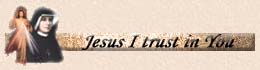
me, "Paint an image according to the pattern you
see, with the signature: Jesus I trust in You. I desire that this image be
venerated, first in your chapel and (then) throughout the world."
"I promise that the soul that will venerate this image will not perish. I
also promise victory over (its) enemies already here on earth, especially at
the hour of death. I Myself will defend it as My own glory."
When I told this to my confessor, I received this for a reply: "That
refers to your soul". He told me, "Certainly, paint God's image in your
soul." When I came out of the confessional, I again heard words such as
these: "My image already is in your soul. I desire
that there be a Feast of Mercy. I want this image, which you will paint with
a brush, to be solemnly blessed on the first Sunday after Easter; that
Sunday is to be the Feast of Mercy. "I desire that priests proclaim this
great mercy of Mine towards souls of sinners. Let the sinner not be afraid
to approach Me. The flames of mercy are burning Me- clamoring to be spent; I
want to pour them out upon these souls".
Jesus complained to me in these words,
"Distrust on the part of souls is tearing at My insides. The distrust of a
chosen soul causes Me even greater pain; despite My inexhaustible love for
them they do not trust in Me. Even My death is not enough for them. Woe to
the soul that abuses these (gifts).
When I spoke about this to Mother Superior (Rose, telling her) that
God had asked this of me, she answered that Jesus should give some sign so
that we could recognize Him more clearly.
When I asked the Lord Jesus for a sign as a proof "that You are truly my God
and Lord and that this request comes from You". I heard this interior voice,
"I will make this all clear to the Superior by
means of the graces which I will grant through this image."
When I tried to run away from these interior inspirations, God said
to me that on the day of judgment He would demand of me a great number of
souls.
Once, exhausted because of these various difficulties that had befallen me
because of what Jesus had said to me and what He had demanded of me for the
painting of this image, I made up my mind to approach Father Endures before
my perpetual vows, and to ask him to dispense me from all these interior
inspirations and from the duty of painting this image. After having heard my
confession, Father Endures gave me this answer: "I will dispense you of
nothing, Sister; it is not right for you to turn away from these interior
inspirations, but you must absolutely - and I say, absolutely - speak about
them to your confessor; otherwise you will go astray despite the great
graces you are receiving from God".
"For the present you are coming to me for confession, but understand,
Sister, that you must have a permanent confessor, that is to say, a
spiritual director."
I was very upset by this. I thought that I would get myself free from
everything, and it turned out quite the opposite - an explicit command to
follow the requests of Jesus. And now, still another torment, as I had no
permanent confessor. Even if I went to the same confessor for a certain
period of time, I could not open my soul to him in respect to these graces,
and this caused me ineffable pain. So I asked Jesus to give these graces to
someone else, because I did not know how to make use of them and was only
wasting them. "Jesus, have mercy on me; do not entrust such great things to
me, as You see that I am a bit of dust and completely inept."
But the goodness of Jesus is infinite; He had promised me visible help here
on earth, and a little while later I received it in Vilnius, in the person
of Father Sopocko. I had already known him before coming to Vilnius, thanks
to an interior vision. One day I saw him in our chapel between the altar and
the confessional and suddenly heard a voice in my soul say,
"This is the visible help for you on earth. He will
help you carry out My will on earth."
(Note Book 1- to be continued)
RETURN TO TOP |
|
CATHOLIC TEACHING/CONVICTION/TESTIMONY |
On Benedict XVI's Africa Trip
"Build a Future of Reconciliation and Stable Peace for All"
VATICAN CITY, APRIL 1, 2009 ( Zenit.org).- Here is a translation of the address Benedict XVI gave today at the general audience in St. Peter's Square.
* * *
Dear Brothers and Sisters,
As I announced last Sunday in the Angelus, I will reflect today on my recent apostolic journey to Africa, the first of my pontificate to that continent. It was limited to Cameroon and Angola, but ideally, with my visit I wished to embrace all the African people and bless them in the name of the Lord. I experienced the traditional warm African welcome, given to me everywhere, and I am pleased to take advantage of this occasion to express again my profound gratitude to the episcopates of both countries, to the heads of state, to all the authorities and to all those who in different ways contributed to the success of this pastoral visit of mine.
My stay in African land began on March 17 in Yaoundé, capital of Cameroon, where I found myself immediately in the heart of Africa, and not just geographically. This country, in fact, has many characteristics of that great continent, the first of them being its profound religious soul, which unites the very numerous ethnic groups that inhabit it. In Cameroon, more than a quarter of the population is Catholic, and they coexist peacefully with the other religious communities. This is why in 1995 my beloved Predecessor John Paul II chose precisely the capital of this nation to promulgate the apostolic exhortation "Ecclesia in Africa," after the first synodal assembly dedicated precisely to the African continent. This time, the Pope returned to hand over the "instrumentum laboris" of the second Synodal Assembly for Africa, planned in Rome for next October, and whose theme will be: "The Church in Africa at the Service of Reconciliation, Justice and Peace: 'You Are the Salt of the Earth .... You Are the Light of the World' (Matthew 5:13-14)."
In the meetings I had -- two days apart -- with the episcopates of Cameroon, and Angola and São Tomé, I wished -- all the more so in this Pauline Year -- to speak about the urgency of evangelization, which is primarily the province of the bishops, underlining the collegial dimension, based on sacramental communion. I exhorted them to be always an example for their priests and for all the faithful, and to follow closely the formation of seminarians that, thanks be to God, are numerous, and of catechists, who are increasingly necessary for the life of the Church. I encouraged the bishops to promote the pastoral care of marriage and the family, of the liturgy and of culture, also to enable the laity to resist the attack of sects and esoteric groups. I wanted to confirm them with affection in the service of charity and of the defense of the rights of the poor.
I recall the solemn celebration of Vespers that took place in Yaoundé, in the Church of Mary Queen of the Apostles, Patroness of Cameroon, a large and modern church, which rises in the place where the first evangelizers of Cameroon worked, the Spiritan Missionaries. On the eve of the Solemnity of St. Joseph, to whose careful custody God entrusted his most precious treasures, Mary and Jesus, we gave glory to the one Father who is in heaven, together with the representatives of other Churches and ecclesial communities. Contemplating the spiritual figure of St. Joseph, who consecrated his life to Christ and the Virgin Mary, I invited priests, consecrated persons and members of ecclesial movements to be always faithful to their vocation, living in the presence of God and in joyful obedience of his Word.
In the apostolic nunciature of Yaoundé I had the opportunity to meet also with the representatives of the Muslim communities of Cameroon, verifying the importance of interreligious dialogue and collaboration between Christians and Muslims to help the world to open to God. It was a truly cordial meeting.
Undoubtedly one of the culminating moments of the journey was the handing over of the "instrumentum laboris" of the Second Synodal Assembly for Africa, which took place on March 19 -- the feastday of St. Joseph and my name day -- in the stadium of Yaoundé, at the end of the solemn Eucharistic celebration in honor of St. Joseph. This occurred in the cordiality of the people of God, "with glad shouts and songs of thanksgiving, a multitude keeping festival" -- as the Psalm says (42:5), of which we have had a concrete experience. The Synodal Assembly will take place in Rome, but in a certain sense it has already started in the heart of the African continent, in the heart of the Christian family that lives, suffers and hopes there. That is why the publication of the "working instrument" seemed to me to be a happy coincidence with the feast of St. Joseph, model of faith and hope as Abraham, the first patriarch. Faith in the "God who is close," who has shown us in Jesus his face of love, is the guarantee of a sure hope, for Africa and for the whole world, guarantee of a future of reconciliation, justice and peace.
After the solemn liturgical assembly and the festive presentation of the working document, I was able to spend time in the apostolic nunciature with members of the Special Council for Africa of the Synod of Bishops, and to live with them a moment of intense communion: We reflected together on the history of Africa from a theological and pastoral perspective. It was almost as the first meeting of the synod itself, in a fraternal debate between the various episcopates and the Pope in view of the synod of reconciliation and peace in Africa. From the beginning Christianity, in fact, and this was visible, has grown deep roots in African soil, as attested by the numerous martyrs and saints, pastors, doctors and catechists that flourished first in the north and later, in subsequent periods, in the rest of the continent: Let us think of Cyprian, Augustine and his mother Monica, Athanasius and then of the martyrs of Uganda, of Giuseppina Bakhita and so many others. In the present age, which witnesses an Africa determined to consolidate its political independence and the building of its national identities in a globalized context, the Church accompanies Africans offering the great message of Vatican Council II, implemented through the first, and now the second special synodal assembly. In the midst of conflicts, unfortunately numerous and tragic, that still afflict the different regions of this continent, the Church knows she is a sign and instrument of unity and reconciliation so that the whole of Africa can build, united, a future of justice, solidarity and peace, carrying out the teachings of the Gospel.
A strong sign of the humanizing action of Christ's message is without a doubt the Cardinal Leger Center of Yaoundé, dedicated to the rehabilitation of disabled people. Its founder was Canadian cardinal Paul-Émil Léger, who wished to retire there after the council in 1968, to work among the poor. In the center, subsequently ceded to the state, I met with numerous brothers and sisters who live in a situation of suffering, sharing with them -- but also receiving from them -- the hope that comes from faith, also in situations of suffering.
Second stage -- and second part of my journey -- was Angola, a country that in certain aspects is emblematic: Having come out of a long internal war, it is now committed to the work of reconciliation and national reconstruction. But how could this reconciliation and reconstruction be genuine if they took place at the cost of the poorest, who have the right as do all to participate in the resources of their land? Herein is the reason why, with this visit of mine, whose first objective as obviously to confirm the faith of the Church, I also wished to encourage the social process in progress. In Angola one touches with one's hand what my venerated predecessors have repeated: Everything is lost with war, everything can be reborn with peace. But to reconstruct a nation, many moral energies are necessary. And because of this, once again, the role of the Church is important, called to develop an educational function, working in depth to renew and form consciences.
St. Paul is the patron of the city of Luanda, capital of Angola: That is why I wanted to celebrate the Eucharist with the priests, seminarians, religious, catechists and the other pastoral agents on Saturday, March 21, in the church dedicated to the Apostle. Once again St. Paul's personal experience spoke to us of his meeting with the Risen Christ, capable of transforming persons and society. The historical contexts change -- and it is necessary to take this into account -- but Christ remains as the true force of the radical renewal of man and of the human community. That is why to return to God, to be converted to Christ, means to go forward, toward the fullness of life.
To express the Church's closeness to Angola's efforts of reconstruction and of so many African regions, I wished to dedicate two special meetings in Luanda to young people and to women respectively. With young people, in the stadium, it was a celebration of joy and hope, saddened unfortunately by the death of two girls, trampled by the crowd at the entrance. Africa is a very young continent, but many of its sons, children and adolescents, have already suffered serious wounds, that only Jesus Christ, crucified and risen, can heal by infusing in them, with his Spirit, the strength to love and to be committed to justice and peace. Then I paid homage to the women for the service that many of them offer to faith, human dignity, life and the family. I reaffirmed their full right to be involved in public life, without hurting, however, their role in the family, an essential mission to develop, always sharing responsibly with the other elements of the society and above all with husbands and fathers.
This is, therefore, the message I gave to the new generations and to the feminine world, extending it also to all in the great Eucharistic assembly of Sunday, March 22, concelebrated with the bishops of the countries of Southern Africa, with the participation of a million faithful. If the African people -- I said to them -- do as ancient Israel did, and base their hope on the Word of God, rich in their religious and cultural heritage, they will really be able to build a future of reconciliation and stable peace for all.
Dear brothers and sisters, how many considerations I have in my heart and how many memories come to mind thinking of this journey! I ask you to thank the Lord for the wonders he has done and continues to do in Africa thanks to the generous action of missionaries, men and women religious, volunteers, priests, catechists, and young communities full of enthusiasm and faith. I also ask you to pray for the peoples of Africa, very dear to me, so that they will be able to address with courage the great social, economic and spiritual challenges of the present moment. I entrust everything and everyone to the maternal intercession of Mary Most Holy, Queen of Africa and of the African saints and blessed.
[Translation by ZENIT]
RETURN TO TOP
|
|
Monthly Index
General Archive
2008
General Archive
2007
General Archive
2006
General Archive 2005
General Archive 2004 |
|
|
|

Hits since 3/16/2004
Màn điện
toán toàn cầu của Thiếu Nhi Fatima được bắt đầu với trang Main từ ngày
9/12/1999,
nhưng
mãi tới Mùa Hè 2001 mới tạm xong,
cuối
cùng đã được chỉnh trang về cả hình thức lẫn nội dung từ mùa hè năm
2002,
để rồi
chính thức tái ra mắt vào ngày 25/3/2003 cho đến nay.
TNFatima.org
do
Thiếu Nhi Fatima
chủ trương và thực hiện
Mọi ý kiến
đóng góp xin gửi về
Webmaster
|
|
|
|
|