| |
| |
|
TRÁI TIM
MẸ: NƠI CON NƯƠNG NÁU - ĐƯỜNG ĐẾN VỚI CHÚA |
|
"Chúa Giêsu muốn dùng con để làm
cho Mẹ được nhận biết và yêu mến" |
|
April 14, 2009 - Tuesday in Easter
Octave
LITURGICAL/THEME MEDITATION:
"I have seen the Lord!"
UNIVERSAL CHURCH/WORLD EVENT(S):
Latin Patriarch's Easter
Sunday Homily
SAINT OF THE DAY
Blessed Peter
Gonzalez
GENERAL
MARIOLOGY
THE DIVINE
HISTORY AND LIFE
OF THE
VIRGIN MOTHER OF GOD
Part Two - Chapter I -
HER PRESENTATION IN THE TEMPLE.
DIVINE MERCY
Divine Mercy in My Soul
Notebook I
TEACHING/TESTIMONY/CONVICTION:
Pope's Homily for Easter
Sunday
|
|
DAILY LITURGICAL MEDITATION |
|
"I have seen the Lord!"
Scripture: John 20:11-18
11 But Mary stood weeping outside the tomb, and as she wept she
stooped to look into the tomb; 12 and she saw two angels in white,
sitting where the body of Jesus had lain, one at the head and one at the
feet. 13 They said to her, "Woman, why are you weeping?" She said to
them, "Because they have taken away my Lord, and I do not know where
they have laid him." 14 Saying this, she turned round and saw Jesus
standing, but she did not know that it was Jesus. 15 Jesus said to her,
"Woman, why are you weeping? Whom do you seek?" Supposing him to be the
gardener, she said to him, "Sir, if you have carried him away, tell me
where you have laid him, and I will take him away." 16 Jesus said to
her, "Mary." She turned and said to him in Hebrew, "Rab-bo'ni!" (which
means Teacher). 17 Jesus said to her, "Do not hold me, for I have not
yet ascended to the Father; but go to my brethren and say to them, I am
ascending to my Father and your Father, to my God and your God." 18
Mary Mag'dalene went and said to the disciples, "I have seen the Lord";
and she told them that he had said these things to her.
Meditation: How easy it is to miss the Lord when our focus is
on ourselves! Mary did not at first recognize the Lord because her focus
was on the empty tomb and on her own grief. It took only one word from
the Master, when he called her by name, for Mary to recognize him.
Mary's message to the disciples, I have seen the Lord, is the
very essence of Christianity. It is not enough that a Christian know
about the Lord, but that we know him personally. It is not enough to
argue about him, but to meet him. In the resurrection we encounter the
living Lord who loves us personally and shares his glory with us. The
Lord gives us "eyes of faith" to see the truth of his resurrection and
victory over sin and death (Ephesians 1:18).
The resurrection of Jesus is the foundation of our hope – the hope
that we will see God face to face and share in his everlasting glory and
joy. Without having seen him you love him; though you do not now see
him you believe in him and rejoice with unutterable and exalted joy. As
the outcome of your faith you obtain the salvation of your souls (1
Peter 1:8-9). Do you recognize the Lord's presence with you, in his
word, in the "breaking of the bread", and in his church, the body of
Christ?
"Lord Jesus, may I never fail to recognize your voice nor lose sight
of your presence in your saving word."
Psalm 33:4-5, 18-22
4 For the word of the LORD is upright; and all his work is done in
faithfulness.
5 He loves righteousness and justice; the earth is full of the steadfast
love of the LORD.
18 Behold, the eye of the LORD is on those who fear him, on those who
hope in his steadfast love,
19 that he may deliver their soul from death, and keep them alive in
famine.
20 Our soul waits for the LORD; he is our help and shield.
21 Yea, our heart is glad in him, because we trust in his holy name.
22 Let thy steadfast love, O LORD, be upon us, even as we hope in thee.
www.dailyscripture.net
RETURN
TO TOP
|
|
UNIVERSAL CHURCH/WORLD EVENTS |
Latin Patriarch's Easter Sunday Homily
"Let Us Look for the Signs of His Resurrection"
JERUSALEM, APRIL 12, 2009 ( Zenit.org).- Here is the homily the Latin patriarch of Jerusalem, Archbishop Michel Sabbah, gave today, Easter Sunday, at the Basilica of the Holy Sepulcher in Jerusalem.
* * *
"They have taken the Lord from the tomb, and we don't know where they put him". Mary Magdalene has lost track of Her Lord and is panicked; she and many others as well.
How very many people are seeking the Lord and yet not finding Him in politics, economics, international justice, and constitutions of so-called modern Christian countries. It is just as Mary Magdalene said: "they have taken the Lord, and we do not know where they have put him."
But for His part God too is seeking to meet up with us, to save us from ourselves by sharing with us His divine nature. Becoming incarnate, He comes into our human story, into the history of our Church, and right into our personal lives. He has found us and we have met Him in our families, in our work, in the small conflicts that entangle us, and in the little sacrifices that we have imposed upon ourselves this Lent. And every time we meet Him, it is Easter.
Where do we meet the Risen one? Jesus told his followers to meet him in Galilee, but Galilee is all the places human beings are to be found: among the poor, the sick, marginalized, the victims of violence, among us sinners and the even among powerful of this world who push Him out from the society and are determined to grant Him no public forum.
But He keeps on coming into our history gratuitously offering His mercy, forgiveness and love. As we meet Him, let His love be believed, lived, celebrated and let our very lives become feasts of love! This is Easter: The historical fact of His resurrection is the guarantee of our own resurrection.
This meeting up the Risen Lord on our journeys gives us believers a special characteristic. It has to be said that we Christians sure do have some nerve! We dare to talk about Easter, joy and the victory over death while at the same time the count of the victims of war, of disease and of natural catastrophes goes up, while each day bombards us with new images of violence and conflict, and in Gaza the Holy Land is cruelly bathed in blood.
We do not forget this. Christ, the one who has promised us victory and peace, knows what suffering is in his heart as well as in his body. Abandoned, rejected in every way, He shared our humanity right to the bitter end, in aguish, in neglect, in the death that He conquered. It is in the midst of failure, physical and moral suffering, periods of solitude, doubt or abandonment, and even as we face death itself that the unheard of announcement of the Resurrection meets us. He comes to meet us there, so we dare to sing our Halleluiah: we have found Him, He is risen and we are risen with Him!
The resurrection is at work each time we choose to give succor and to love his Jesus in our neighbor; each time we prefer His forgiveness to hate, each time that we allow love and peace to claim a place among men.
The resurrection is in the new children of God that are born through baptism and in each time we feel ourselves to be living members of this Church: not dead or dormant members, but living, conscious, faithful and responsible members who are joyful and positive.
Let us look for the signs of His resurrection, like the apostle John entering the tomb. "He saw and he believed" because of the simple clues, the shroud and the head cloth lying in place, sunken in on themselves, empty of the corps that had been wrapped up in them. The resurrection often shows itself through tiny clues, not always through great events. The one who loves in Christ, though he be wounded, sees these signs and shouts "Halleluiah."
On this Easter day we have to proclaim our Halleluiah, first of all with our families and among ourselves. We must, however, not be ashamed of showing our faith in the Risen Jesus to those on the outside through our witness, our joy and our fraternal charity. Let us have courage to be ourselves in front of God and men!
Have a blessed feast, a safe trip home and happy Easter to all!
+ Fouad Twal, Patriarch
RETURN
TO TOP
|
|
DAILY LITURGICAL SAINT |
|

April 14, 2009
Blessed
Peter Gonzalez
(d.
1246)
St.
Paul
had a conversion experience on the road to Damascus. Many years later,
the same proved true for Peter Gonzalez, who triumphantly rode his horse
into the Spanish city of Astorga in the 13th century to take
up an important post at the cathedral. The animal stumbled and fell,
leaving Peter in the mud and onlookers amused.
Humbled, Peter reevaluated his motivations (his bishop-uncle had secured
the cathedral post for him) and started down a new path. He became a
Dominican priest and proved to be a most effective preacher. He spent
much of his time as court chaplain, and attempted to exert positive
influence on the behavior of members of the court. After King Ferdinand
III and his troops defeated the Moors at Cordoba, Peter was successful
in restraining the soldiers from pillaging and persuaded the king to
treat the defeated Moors with compassion.
After retiring from the court Peter devoted the remainder of his life to
preaching in northwest Spain. He developed a special mission to Spanish
and Portuguese seamen. He is the patron of sailors.
Peter Gonzalez died in 1246 and was beatified in 1741.
http://www.americancatholic.org/Features/SaintofDay
RETURN TO TOP
|
|
GENERAL
MARIOLOGY |
THE DIVINE HISTORY AND
LIFE
OF THE
VIRGIN MOTHER OF GOD
BOOK TWO
Treats of the Presentation
of the Princess of Heaven in the Temple, the
Favors She Received at the Hand of God, the Sublime
Perfection
with which She Observed the Rules of the Temple,
the Heavenly Excellence of Her Heroic Virtues
and Visions, Her Most Holy Espousal and
other Events up to the Incarnation
of the Son of God
CHAPTER I
HER PRESENTATION IN THE TEMPLE.
The Most High was much pleased with the petition of
the heavenly Child and He gave Her to understand that He would admit Her
to suffering and labor for his love in the course of her life, without
at the time revealing to Her the order and the manner in which He was to
dispense them. The Princess of heaven gave thanks for this blessing and
favor of being chosen to labor and suffer for the glory of God’s name.
Burning with desire of securing such favor, She asked of his Majesty to
be allowed to make four vows in his presence: of chastity, of poverty,
of obedience, and of perpetual enclosure in the temple whither He had
called Her. To this petition the Lord answered and said to Her: "My
Spouse, my thoughts rise above all that is created, and thou, my chosen
one, dost not yet know what is to happen to thee in the course of thy
life, and thou dost not yet understand why it is impossible to fulfill
thy fervent desires altogether in the manner in which thou now dost
imagine. The vow of chastity I permit and I desire that thou make it; I
wish that from this moment thou renounce earthly riches. It is also my
will that as far as possible thou observe whatever pertains to the other
vows, just as if thou hadst made them all. Thy desire shall be fulfilled
through many other virgins in the coming law of grace; for, in order to
imitate thee and to serve Me, they will make these same vows and live
together in community and thou shalt be the Mother of many daughters."
The most holy Child then, in the presence of the
Lord, made the vow of chastity and as for the rest without binding
Herself, She renounced all affection for terrestrial and created things.
She moreover resolved to obey all creatures for the sake of God. In the
fulfillment of these promises She was more punctual, fervent and
faithful than any who have ever made these vows or ever will make them.
Forthwith the clear and intuitive vision of the Divinity ceased, but She
was not immediately restored to the earth. For, remaining in the
empyrean heaven, She enjoyed another, an imaginary vision of the Lord in
a lower state of ecstasy, so that in connection with it, She saw other
mysteries.
In this secondary and imaginary vision some of the
seraphim closest to the Lord approached Her and by his command adorned
and clothed Her in the following manner. First all her senses were
illumined with an effulgent light, which filled them with grace and
beauty. Then they robed Her in a mantle or tunic of most exquisite
splendor, and girded Her with a cincture of vary-colored and transparent
stones, of flashing brilliancy, which adorned Her beyond human
comprehension. They signified the immaculate purity and the various
heroic virtues of her soul. They placed on Her also a necklace or collar
of inestimable and entrancing beauty, which contained three large
stones, symbolic of the three great virtues of faith, hope and charity;
this they hung around her neck letting it fall to her breast as if
indicating the seat of these precious virtues. They also adorned her
hands with seven rings of rare beauty whereby the Holy Ghost wished to
proclaim that He had enriched Her with his holy gifts in a most eminent
degree. In addition to all this the most holy Trinity crowned her head
with an imperial diadem, made of inestimable material and set with most
precious stones, constituting Her thereby as his Spouse and as the
Empress of heaven. In testimony whereof the white and refulgent
vestments were emblazoned with letters or figures of the finest and the
most shining gold, proclaiming: Mary, Daughter of the eternal Father,
Spouse of the Holy Ghost and Mother of the true Light. This last name or
title the heavenly Mistress did not understand; but the angels
understood it, who, lost in wonder and praise of the Author, were
assisting at this new and strange ceremony. Finally the attention of all
the angelic spirits was drawn toward the Most High and a voice proceeded
from the throne of the blessed Trinity, which, addressing the most holy
Mary, spoke to Her: "Thou shalt be our Spouse, our beloved and chosen
One among all creatures for all eternity; the angels shall serve thee
and all the nations and generations shall call thee blessed" (Luc. 1,
48).
The sovereign Child being thus attired in the court
dress of the Divinity, then celebrated a more glorious and marvelous
espousal than ever could enter the mind of the highest cherubim and
seraphim. For the Most High accepted Her as his sole and only Spouse and
conferred upon Her the highest dignity which can befall a creature; He
deposited within Her his own Divinity in the person of the Word and with
it all the treasures of grace befitting such eminence. Meanwhile the
most Humble among the humble was lost in the abyss of love and wonder
which these benefits and favors caused in Her , and in the presence of
the Lord She spoke: "Most high King and incomprehensible God, who art
Thou and who am I , that thy condescension should look upon me who am
dust, unworthy of such mercy? In Thee, my Lord, as in a clear mirror
seeing thy immutable being, I behold and understand without error my
lowliness and vileness, I admire thy immensity and deprecate my
nothingness. At the sight of Thee I am annihilated and lost in
astonishment, that the infinite Majesty should stoop to so lowly a worm,
who can merit only oblivion and contempt of all the creatures. O Lord,
my only Good, how art Thou magnified and exalted in this deed! What
marvel dost Thou cause through me in thy angelic spirits, who understand
thy infinite bounty, magnificence and mercy in raising up from the dust
her who in it is poor, and placing her among the princes (Ps. 112, 7)! I
accept Thee, O my King and my Lord, as my Spouse and I offer myself as
thy slave. Let not my understanding attend to any other object, nor my
memory hold any other image, nor my will seek other object or pleasure
than Thee, my highest Good, my true and only Love. Let not my eyes look
upon human creature, nor my faculties and senses attend upon anything
beside Thee and whatever thy Majesty shall direct. Thou alone for thy
spouse, my Beloved, and she for Thee only, who art the immutable and
eternal Good."
The Most High received with ineffable pleasure this
consent of the sovereign Princess to enter into the new espousal with
her most holy soul. As upon his True Spouse and as Mistress of all
creation, He now lavished upon Her all the treasures of his grace and
power, instructing Her to ask for whatever She desired and assuring Her
that nothing would ever be denied Her. The most humble Dove at once
proceeded to beseech the Lord with the most burning charity, to send His
Onlybegotten to the world as a remedy for mortals; that all men be
called to the true knowledge of his Divinity; that her natural parents,
Joachim and Anne, receive an increase of the loving gifts of his right
hand; that the poor and afflicted be consoled and comforted in their
troubles; and that in Herself be fulfilled the pleasure of the divine
will. These were some of the more express petitions addressed by the new
Spouse on this occasion to the blessed Trinity. And all the angelic host
sang new songs of admiration in praise of the Most High, while those
appointed by his Majesty, midst heavenly music, bore back the holy Child
from the empyrean heaven to the place in the temple, from which they had
brought Her.
RETURN TO TOP
|
|
DIVINE MERCY
|

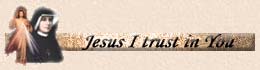
Divine Mercy In my soul
Notebook I
(continued)
When for
the first time this moment was drawing near, I was snatched from it by
virtue of holy obedience. The Directness of Novices, alarmed by my
appearance, sent me off to confession, but the confessor did not understand
me, and I experienced no relief whatsoever, O Jesus, give us experienced
priests!
When I told this priest I was undergoing infernal tortures, he answered that
he was not worried about my soul, because he saw in it a great grace of God.
But I understood nothing of this, and not even the least glimmer of light
broke through my soul.
Then my physical strength began to fail me, and I could no longer carry out
my duties. Nor could I any longer hide my sufferings. Although I did not say
a word about them, the look of pain on my face betrayed me. The Superior
told me that the sisters had come to her saying that, when they look at me
in the chapel, they are moved to pity because I look so terrible. Yet
despite all efforts, the soul is unable to conceal such suffering.
Jesus, You alone know how the soul, engulfed in darkness, moans and the
midst of these torments and, despite all this, thirsts for God as burning
lips thirst for water. It dies and withers; it dies a death without death;
that is to say, it cannot die. All its efforts come to nothing; it is under
a powerful hand. Now the soul comes under the power of the Just One. All
exterior temptations cease; all that surrounds it becomes silent like a
dying person who loses contact with everything around it; the person's whole
soul is in the hand of the Just God, the Thrice - Holy God, - rejected for
all eternity! This is the culminating moment, and God alone can test a soul
in this way, because He alone knows what the soul can endure.
When the soul has been saturated through and through by this infernal fire,
it is, as it were, cast head long into great despair. My soul experienced
this moment when I was alone in my cell. When my soul began to sink into
despair. I felt that the end was near. But I seized my little crucifix and
clutched it tightly in my hand. And now I felt my body separate itself from
my soul; and though I wanted to go to my Superiors, I no longer had the
physical strength. I uttered my last words: "I trust in Your Mercy!" - and
it seemed to me that I provoked God to an even greater anger. And now I was
drowned in despair, and all that was left me was a moan of unadulterated
pain which, from time to time, tore itself from my soul. The soul is in
agony - and it seemed to me that my soul would remain in this state, because
by my own strength I could not emerge from it. Every recollection of God
opened up an unspeakable ocean of suffering, and yet despite this there is
something with in the soul which is drawn to Him, though it seems to her for
this only - that she suffer more. The memory of the love with which God
formerly surrounded it is still another kind of suffering. His gaze pierces
it, and everything within the soul is burned by this gaze.
After sometime, one of the sisters came into the cell and found me almost
dead. She was frightened and went to find the Directness of Novices who, in
the name of holy obedience ordered me to get up from the ground. My strength
returned immediately, and I got up trembling. The Directness recognized
immediately the state of my soul and spoke to me about the inscrutable mercy
of God, saying "Do not be distressed about anything, Sister. I command this
of you in virtue of obedience". Then she said to me, "I see now Sister, that
God is calling you to a high degree of holiness; the Lord wants to draw you
to a high degree of holiness; the Lord wants to draw you very close to
Himself since He has allowed these things to happen to you so soon. Be
faithful to God, Sister, because this is a sign that He wants you to have a
high place in heaven". However, I did not understand anything of these
words. When I went into the chapel, I felt as though my soul had been set
free from everything, as though I had just come forth from the hand of God.
I perceived the inviolability of my soul; I felt that I was a tiny child.
Suddenly I saw the Lord interiorly, and He said to me,
"Fear not, My daughter; I am with you".
In that single moment, all the
darkness and torments vanished, my senses were inundated and unspeakable
joy, (and) the faculties of my soul filled with light.
I want to add that, although my soul was already in the rays of His love,
traces of my past tortures remained on my body for two days: a deathly pale
face and bloodshot eyes. Jesus alone knows what I suffered. What I have
written is very poor compared to the reality. I cannot put it in words; it
seemed to me that I had come back from the other world. I feel an aversion
for everything that is created; I snuggle to the heart of God like a baby to
its mother's breast. I see everything differently now. I am conscious of
what the Lord, by one single word, has done in my soul, and I live by it. I
shudder at the recollection of this past torture. I would not have believed
that one could suffer so, if I had not gone through it myself. This is a
completely spiritual suffering.
(Note Book 1- to be continued)
RETURN TO TOP |
|
CATHOLIC TEACHING/CONVICTION/TESTIMONY |
Pope's Homily for Easter Sunday
Christ "Is Our Hope, He Is the True Peace of the World"
VATICAN CITY, APRIL 12, 2009 ( Zenit.org).- Here is the homily Benedict XVI gave at Easter Mass today in St. Peter's Basilica.
* * *
Dear Brothers and Sisters,
"Christ, our Paschal lamb, has been sacrificed!" (1 Cor 5:7). On this day, Saint Paul’s triumphant words ring forth, words that we have just heard in the second reading, taken from his First Letter to the Corinthians. It is a text which originated barely twenty years after the death and resurrection of Jesus, and yet – like many Pauline passages – it already contains, in an impressive synthesis, a full awareness of the newness of life in Christ. The central symbol of salvation history – the Paschal lamb – is here identified with Jesus, who is called "our Paschal lamb". The Hebrew Passover, commemorating the liberation from slavery in Egypt, provided for the ritual sacrifice of a lamb every year, one for each family, as prescribed by the Mosaic Law. In his passion and death, Jesus reveals himself as the Lamb of God, "sacrificed" on the Cross, to take away the sins of the world. He was killed at the very hour when it was customary to sacrifice the lambs in the Temple of Jerusalem. The meaning of his sacrifice he himself had anticipated during the Last Supper, substituting himself – under the signs of bread and wine – for the ritual food of the Hebrew Passover meal. Thus we can truly say that Jesus brought to fulfilment the tradition of the ancient Passover, and transformed it into his Passover.
On the basis of this new meaning of the Paschal feast, we can also understand Saint Paul’s interpretation of the "leaven". The Apostle is referring to an ancient Hebrew usage: according to which, on the occasion of the Passover, it was necessary to remove from the household every tiny scrap of leavened bread. On the one hand, this served to recall what had happened to their forefathers at the time of the flight from Egypt: leaving the country in haste, they had brought with them only unleavened bread. At the same time, though, the "unleavened bread" was a symbol of purification: removing the old to make space for the new. Now, Saint Paul explains, this ancient tradition likewise acquires a new meaning, once more derived from the new "Exodus", which is Jesus’ passage from death to eternal life. And since Christ, as the true Lamb, sacrificed himself for us, we too, his disciples – thanks to him and through him – can and must be the "new dough", the "unleavened bread", liberated from every residual element of the old yeast of sin: no more evil and wickedness in our heart.
"Let us celebrate the feast … with the unleavened bread of sincerity and truth". This exhortation from Saint Paul, which concludes the short reading that was proclaimed a few moments ago, resounds even more powerfully in the context of the Pauline Year. Dear brothers and sisters, let us accept the Apostle’s invitation; let us open our spirit to Christ, who has died and is risen in order to renew us, in order to remove from our hearts the poison of sin and death, and to pour in the life-blood of the Holy Spirit: divine and eternal life. In the Easter Sequence, in what seems almost like a response to the Apostle’s words, we sang: "Scimus Christum surrexisse a mortuis vere" – we know that Christ has truly risen from the dead. Yes, indeed! This is the fundamental core of our profession of faith; this is the cry of victory that unites us all today. And if Jesus is risen, and is therefore alive, who will ever be able to separate us from him? Who will ever be able to deprive us of the love of him who has conquered hatred and overcome death?
The Easter proclamation spreads throughout the world with the joyful song of the Alleluia. Let us sing it with our lips, and let us sing it above all with our hearts and our lives, with a manner of life that is "unleavened", that is to say, simple, humble, and fruitful in good works. "Surrexit Christus spes mea: precedet suos in Galileam" – Christ my hope is risen, and he goes before you into Galilee. The Risen One goes before us and he accompanies us along the paths of the world. He is our hope, He is the true peace of the world. Amen!
© Copyright 2009 -- Libreria Editrice Vaticana
RETURN TO TOP
|
|
Monthly Index
General Archive
2008
General Archive
2007
General Archive
2006
General Archive 2005
General Archive 2004 |
|
|
|

Hits since 3/16/2004
Màn điện
toán toàn cầu của Thiếu Nhi Fatima được bắt đầu với trang Main từ ngày
9/12/1999,
nhưng
mãi tới Mùa Hè 2001 mới tạm xong,
cuối
cùng đã được chỉnh trang về cả hình thức lẫn nội dung từ mùa hè năm
2002,
để rồi
chính thức tái ra mắt vào ngày 25/3/2003 cho đến nay.
TNFatima.org
do
Thiếu Nhi Fatima
chủ trương và thực hiện
Mọi ý kiến
đóng góp xin gửi về
Webmaster
|
|
|
|
|